Event List
retrieve:
Return the details about the given Event id.
list:
List all Event objects.
GET /api/v1/events/?format=api&offset=170&ordering=event__place_and_room
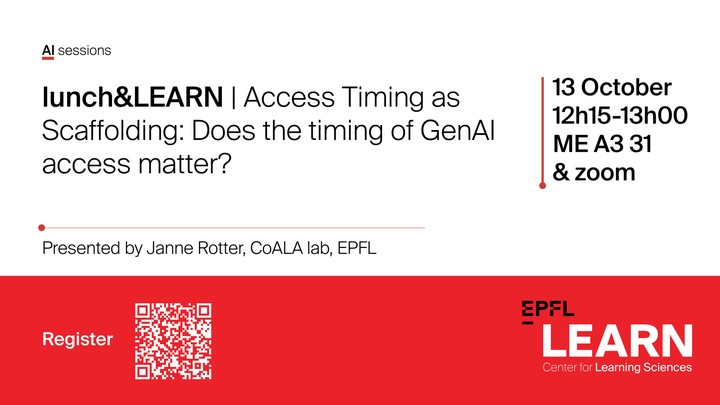
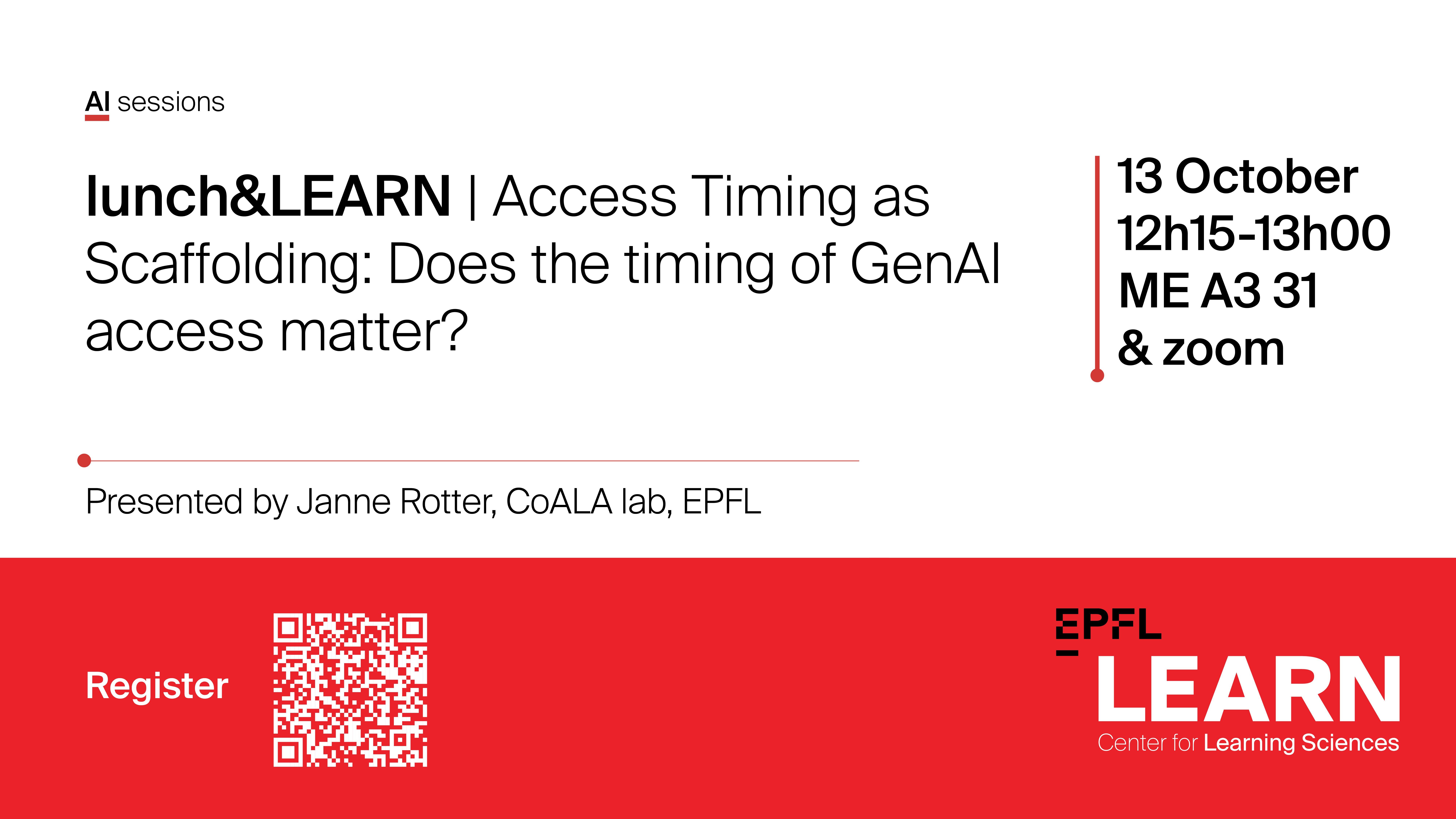
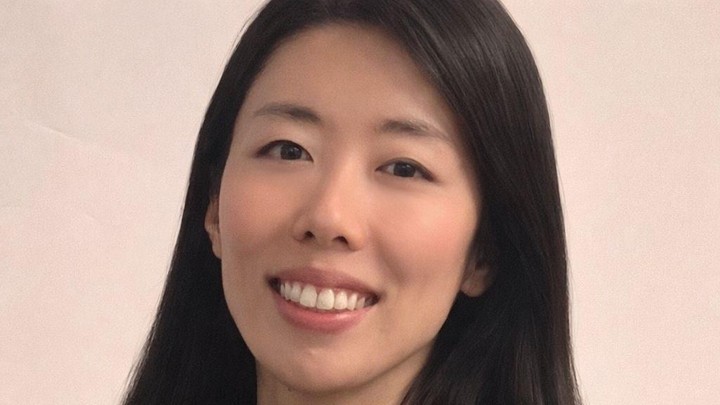
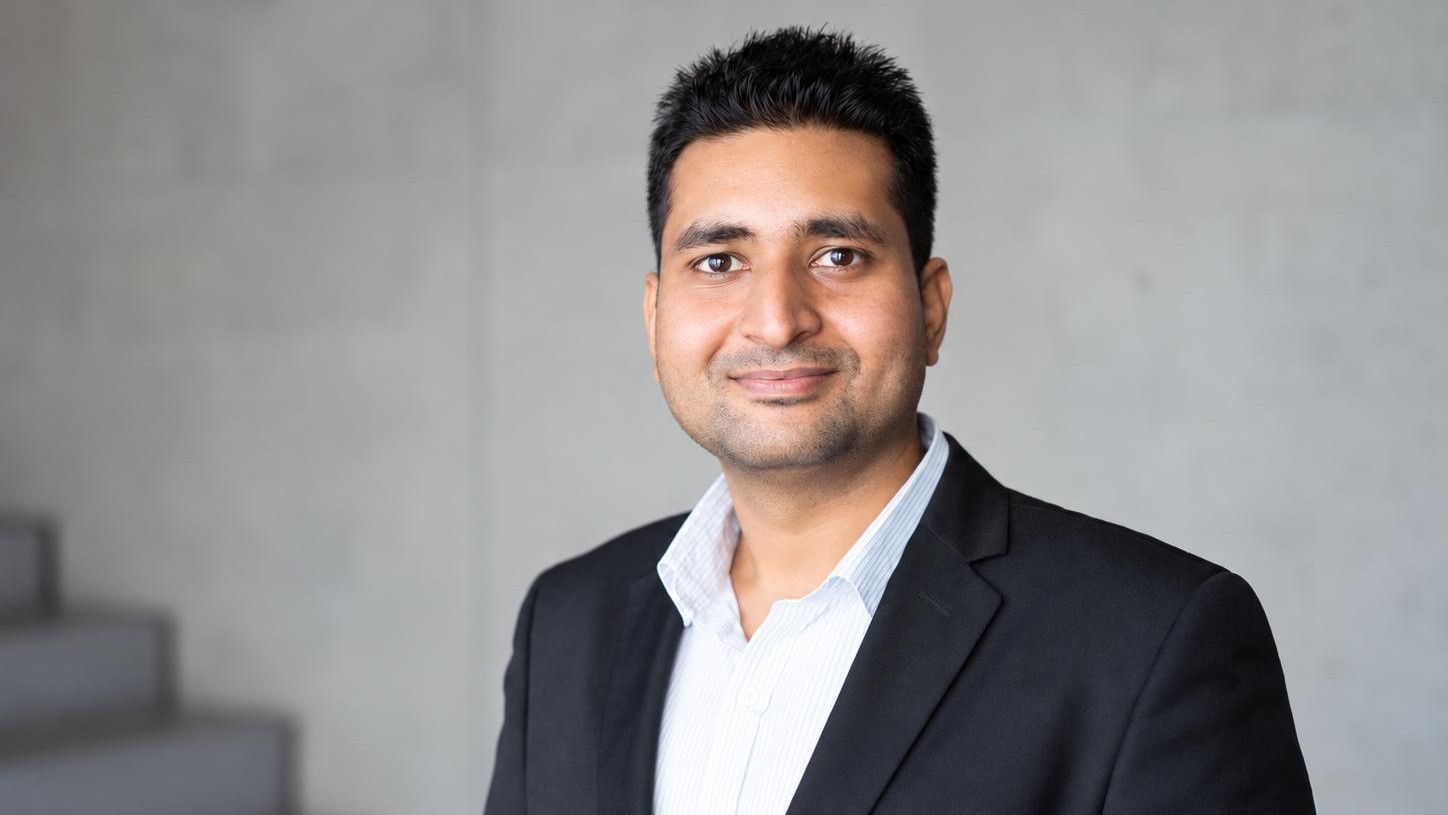
{ "count": 264, "next": "https://memento.epfl.ch/api/v1/events/?format=api&limit=10&offset=180&ordering=event__place_and_room", "previous": "https://memento.epfl.ch/api/v1/events/?format=api&limit=10&offset=160&ordering=event__place_and_room", "results": [ { "id": 72673, "title": "lunch&LEARN | Access Timing as Scaffolding: Does the timing of GenAI access matter?", "slug": "lunchlearn-access-timing-as-scaffolding-does-the-3", "event_url": "https://memento.epfl.ch/event/lunchlearn-access-timing-as-scaffolding-does-the-3", "visual_url": "https://memento.epfl.ch/image/33899/200x112.jpg", "visual_large_url": "https://memento.epfl.ch/image/33899/720x405.jpg", "visual_maxsize_url": "https://memento.epfl.ch/image/33899/max-size.jpg", "lang": "en", "start_date": "2026-10-13", "end_date": "2026-10-13", "start_time": "12:15:00", "end_time": "13:00:00", "description": "<p>Generative AI has become a part of students' everyday working life. If used without guidance, GenAI can cause over-reliance and leave students with a distorted sense of what they have actually learned. Most research and practice have focused on how we can scaffold students' GenAI use, for example through prompts, guardrails, or redesigned tasks. This talk asks a simpler question that has received far less attention. When should students be allowed to use AI so that it helps their learning?<br>\r\n<br>\r\nIn this lunch&LEARN session, Janne Rotter turns to a question that's been largely overlooked: not how, but when should students be allowed to use AI for it to actually support learning? Janne will present findings from a study of 105 university students comparing three conditions: unrestricted AI access, no access at all, and a \"timed\" condition where students could only turn to AI after first attempting the task on their own.<br>\r\n<br>\r\nDrawing on multiple pedagogical theories to build a decision rule for when access should open up, the results show that students in the timed condition outperformed those with unrestricted access on an objective post-test, and had a more accurate sense of their own understanding, without an explicit metacognitive prompting. Compared to withholding AI entirely, timed access also seemed to reduce task errors and time spent on task.<br>\r\n<br>\r\nJoin us to learn more about the topic and engage in further discussion. <br>\r\n </p>", "image_description": "", "creation_date": "2026-09-24T15:53:46", "last_modification_date": "2026-09-28T15:37:37", "link_label": "Registration/zoom", "link_url": "https://epfl.zoom.us/meeting/register/9pBBuqZHQge7OmGTm0Kedg#/registration", "canceled": "False", "cancel_reason": "", "place_and_room": "ME A3 31", "url_place_and_room": "https://plan.epfl.ch/?room==ME%20A3%2031", "url_online_room": "https://epfl.zoom.us/meeting/register/9pBBuqZHQge7OmGTm0Kedg#/registration", "spoken_languages": [ "https://memento.epfl.ch/api/v1/spoken_languages/2/?format=api" ], "speaker": "<a href=\"https://people.epfl.ch/janne.rotter?lang=en\">Janne Rotter</a>", "organizer": "<a href=\"https://learn.epfl.ch/en/homepage/\">Center LEARN</a>", "contact": "<a href=\"mailto:[email protected]\">[email protected]</a>", "is_internal": "True", "theme": "", "vulgarization": { "id": 2, "fr_label": "Public averti", "en_label": "Informed public" }, "registration": { "id": 1, "fr_label": "Sur inscription", "en_label": "Registration required" }, "keywords": "lunch&LEARN, Center LEARN, teaching, learning, AI", "file": null, "icalendar_url": "https://memento.epfl.ch/event/export/121926/", "category": { "id": 1, "code": "CONF", "fr_label": "Conférences - Séminaires", "en_label": "Conferences - Seminars", "activated": true }, "academic_calendar_category": null, "domains": [], "mementos": [ "https://memento.epfl.ch/api/v1/mementos/3/?format=api", "https://memento.epfl.ch/api/v1/mementos/6/?format=api", "https://memento.epfl.ch/api/v1/mementos/8/?format=api", "https://memento.epfl.ch/api/v1/mementos/65/?format=api", "https://memento.epfl.ch/api/v1/mementos/85/?format=api", "https://memento.epfl.ch/api/v1/mementos/145/?format=api", "https://memento.epfl.ch/api/v1/mementos/323/?format=api", "https://memento.epfl.ch/api/v1/mementos/416/?format=api" ] }, { "id": 72724, "title": "Designing Social Robots with Older Adults: Context, Adaptation, and Dignity", "slug": "designing-social-robots-with-older-adults-context", "event_url": "https://memento.epfl.ch/event/designing-social-robots-with-older-adults-context", "visual_url": "https://memento.epfl.ch/image/33940/200x112.jpg", "visual_large_url": "https://memento.epfl.ch/image/33940/720x405.jpg", "visual_maxsize_url": "https://memento.epfl.ch/image/33940/max-size.jpg", "lang": "en", "start_date": "2026-11-11", "end_date": "2026-11-11", "start_time": "11:00:00", "end_time": "12:00:00", "description": "<p>How social robots look, behave, and offer support should reflect the people and environments they encounter. Drawing on studies with older adults in rural Indiana and urban Houston, this talk examines how individual needs, preferences, everyday surroundings, and care relationships can inform the physical forms and interaction styles of future social robots.<br>\r\n<br>\r\nThrough participatory design, observations, and interviews, I center older adults’ perspectives on meaningful support, acceptable interaction, and personal boundaries. Encounters with robot companions have brought moments of enjoyment, surprise, and support, while revealing challenges involving communication, expectations, privacy, and control. I explore how embodiment, movement, voice, and interaction pacing shape these experiences, and how caregivers can support engagement while preserving older adults’ choices and dignity.<br>\r\n<br>\r\nThese findings inform design requirements for robots that people can understand, guide, and adjust as their circumstances change. I connect them to opportunities for adaptive robot behavior, accessible interaction, and shared control, including how robots might recognize when assistance is welcome and make their actions easier to interpret or interrupt. The talk positions older adults as active contributors to robotics research, whose lived expertise can shape both future robot companions and the broader systems of support surrounding them.<br>\r\n<br>\r\n<br>\r\n<strong>Biography</strong><br>\r\nChorong Park, Ph.D., is an Assistant Professor and Presidential Frontier Faculty at the University of Houston’s Gerald D. Hines College of Architecture and Design, where she leads the Empathetic Lifespan AI & Robotics for Aging (ELARA) Lab. Her research connects human–robot interaction, human-centered AI, and participatory design to develop social robots and supportive technologies with older adults and caregivers.<br>\r\n<br>\r\nDrawing on studies in rural Indiana and urban Houston, she investigates how robots’ physical forms and interactions can fit older adults’ needs, surroundings, and everyday lives. Her work centers older adults’ perspectives on companionship, support, privacy, personal boundaries, and dignity, including how caregiver involvement can preserve individual choice and control.<br>\r\n<br>\r\nHer research is informed by more than 500 hours of volunteer technology support with older adults and people with disabilities and has appeared at ACM CHI, ACM ASSETS, and IEEE robotics venues. She earned her Ph.D. in Technology, with a graduate minor in Gerontology, and her master’s degree in UX Design from Purdue University.<br>\r\n<br>\r\n<u>Further information</u>:<br>\r\nUniversity of Houston research feature<br>\r\n(<a href=\"https://stories.uh.edu/2026-ai-robots-for-older-adults/index.html\">https://stories.uh.edu/2026-ai-robots-for-older-adults/index.html</a>)<br>\r\nELARA Lab website<br>\r\n(<a href=\"https://elaralab.org/\">https://elaralab.org</a>/)<br>\r\n </p>", "image_description": "", "creation_date": "2026-09-30T16:15:15", "last_modification_date": "2026-09-30T16:25:59", "link_label": "", "link_url": "", "canceled": "False", "cancel_reason": "", "place_and_room": "ME A3 31", "url_place_and_room": "https://plan.epfl.ch/?room==ME%20A3%2031", "url_online_room": "https://epfl.zoom.us/j/69492652047", "spoken_languages": [ "https://memento.epfl.ch/api/v1/spoken_languages/2/?format=api" ], "speaker": "<a href=\"https://elaralab.org/\">Prof. Chorong Park</a>", "organizer": "<a href=\"https://www.epfl.ch/research/domains/robotics/\">Robotics Center</a>", "contact": "<a href=\"https://people.epfl.ch/anca.rusu?lang=en\">Anca Rusu</a>", "is_internal": "False", "theme": "", "vulgarization": { "id": 2, "fr_label": "Public averti", "en_label": "Informed public" }, "registration": { "id": 3, "fr_label": "Entrée libre", "en_label": "Free" }, "keywords": "", "file": null, "icalendar_url": "https://memento.epfl.ch/event/export/122004/", "category": { "id": 1, "code": "CONF", "fr_label": "Conférences - Séminaires", "en_label": "Conferences - Seminars", "activated": true }, "academic_calendar_category": null, "domains": [], "mementos": [ "https://memento.epfl.ch/api/v1/mementos/1/?format=api", "https://memento.epfl.ch/api/v1/mementos/6/?format=api", "https://memento.epfl.ch/api/v1/mementos/8/?format=api", "https://memento.epfl.ch/api/v1/mementos/416/?format=api" ] }, { "id": 72636, "title": "H∞boys and INDIans: Can they work together for flight control?", "slug": "hboys-and-indians-can-they-work-together-for-fligh", "event_url": "https://memento.epfl.ch/event/hboys-and-indians-can-they-work-together-for-fligh", "visual_url": "https://memento.epfl.ch/image/33880/200x112.jpg", "visual_large_url": "https://memento.epfl.ch/image/33880/720x405.jpg", "visual_maxsize_url": "https://memento.epfl.ch/image/33880/max-size.jpg", "lang": "en", "start_date": "2026-10-07", "end_date": "2026-10-07", "start_time": "11:00:00", "end_time": "12:00:00", "description": "<strong>Abstract</strong><br>\r\nSince the early days of aircraft autopilots, flight control law design has been dominated by gain scheduling: a family of linear controllers designed at trim points across the flight envelope and interpolated as the aerospace vehicle's operating condition changes. The approach is reliable and well understood, but it is also labor-intensive, requiring extensive linearization, controller interpolation, and lengthy re-tuning whenever the airframe or mission profile changes while its classical stability and performance guarantees hold only under restrictive assumptions.<br>\r\n<br>\r\n(Incremental) Nonlinear Dynamic Inversion — (I)NDI — emerged as an attractive alternative, first as full-state NDI in the 1980s–90s and later, in its incremental form, replacing much (though not all) of the reliance on an accurate onboard model with direct sensor feedback of angular acceleration. The result is a simple, largely envelope-independent control structure that (almost) eliminates the scheduling and interpolation burden. The price, however, is the loss of the a priori robustness guarantees that gain-scheduled designs, however cumbersome, were built to provide. Robust control theory, born in the same timeframe as NDI, offers exactly those guarantees, but has traditionally lived in a separate, frequency-domain world from INDI's incremental, time-domain philosophy.<br>\r\n<br>\r\nThis talk shows how the two could be brought closer or even work together. We present hybrid INDI architectures combining a sensor-based and a model-based inversion core and paired with an outer loop tuned via structured synthesis therefore combining the advantages of both worlds. We then generalize this bridge through a formal duality between (I)NDI and quasi-LPV control, unifying robust analysis and synthesis across both worlds and clarifying exactly where INDI's modularity is paid for in achievable robustness. These results are validated across various aerospace applications such as aircraft, space launchers and drones.<br>\r\n<br>\r\n<strong>Biography</strong><br>\r\n<br>\r\nDr. Spilios Theodoulis is an associate professor in the Aerospace GNC cluster within the Control & Simulation (C&S) section, at the Faculty of Aerospace Engineering (AE) of the Delft University of Technology (TU Delft). Before joining TU Delft, he spent fourteen years at the French-German Research Institute of Saint-Louis (ISL), where he was Deputy Head of the GNC department. He is the founder of the Aerospace dynamics and RObust Control (AEROCON) research group along with its advanced projects branch—the ∞-Lab, and also an adjunct professor at the University of Strasbourg, University of Paris-Saclay and Cranfield University teaching tensor-based flight dynamics and automatic (flight) control. He has been involved in the research and development of both civilian and defense projects with EU government agencies, industry and academia in the field of GNC for more than 20 years.<br>\r\n<br>\r\nHis research interests focus on two complementary fields. First, <em>modeling and flight dynamics</em> of complex aerospace systems, including uncertainty modeling and linear/nonlinear-parameter-varying dynamics. Second, (multivariable) <em>stability and</em> <em>control</em> systems spanning from robust/nonlinear control and analysis to control theory-inspired guidance algorithms. The algorithms developed are showcased in several classes of systems (including the facilities of the AE C&S section such as SIMONA, PH-LAB, etc.) such as civil and fighter aircraft, rotorcraft, drones, hypersonic vehicles, space launchers, as well as guided systems. He maintains active collaborations with leading research institutes, including ONERA, DLR, NLR, TNO, NASA, and ESA-ESTEC; academic partners such as ISAE-SUPAERO, Cranfield University, and NYU Abu Dhabi; and industrial partners including Dassault Aviation, Airbus Defence & Space, MBDA, Indra Deimos, PLD Space, Lockheed Martin Skunk Works, and others.<br>\r\n<br>\r\nHe is an Associate Fellow of the American Institute of Aeronautics and Astronautics (Class of 2023), co-recipient of both <em>1-Star</em> and <em>2-Star Innovation Awards</em> (2019) from MBDA, and his students have received (some) distinctions, including the best PhD award in the area of systems and control from the University of Strasbourg (2017). He also serves on various technical committees (AIAA GNC, IFAC Aerospace, CEAS GNC) as well as on the organizing and program conference committees related to the field of GNC (AIAA SciTech, IFAC WC/ACA, EuroGNC, etc.).<br>\r\n<br>\r\nHis most daunting challenge to date though, remains the robust stabilization of his two young daughters Iris and Hera, who are constantly reminding him that nature is neither linear nor time-invariant.<br>\r\n<br>\r\n<br>\r\n ", "image_description": "", "creation_date": "2026-09-22T11:05:26", "last_modification_date": "2026-09-22T16:45:19", "link_label": "", "link_url": "", "canceled": "False", "cancel_reason": "", "place_and_room": "ME C2 405", "url_place_and_room": "https://plan.epfl.ch/?room==ME%20C2%20405", "url_online_room": "", "spoken_languages": [ "https://memento.epfl.ch/api/v1/spoken_languages/2/?format=api" ], "speaker": "<a href=\"https://www.tudelft.nl/en/staff/s.theodoulis/\">Dr. Spilios Theodoulis, associate professor in the Aerospace GNC cluster within the Control & Simulation (C&S) section, at the Faculty of Aerospace Engineering (AE) of the Delft University of Technology (TUDelft), Netherlands</a>", "organizer": "Professor <a href=\"https://people.epfl.ch/alireza.karimi\">Alireza Karimi</a>", "contact": "[email protected]", "is_internal": "False", "theme": "", "vulgarization": { "id": 1, "fr_label": "Tout public", "en_label": "General public" }, "registration": { "id": 3, "fr_label": "Entrée libre", "en_label": "Free" }, "keywords": "", "file": null, "icalendar_url": "https://memento.epfl.ch/event/export/121878/", "category": { "id": 1, "code": "CONF", "fr_label": "Conférences - Séminaires", "en_label": "Conferences - Seminars", "activated": true }, "academic_calendar_category": null, "domains": [], "mementos": [ "https://memento.epfl.ch/api/v1/mementos/8/?format=api", "https://memento.epfl.ch/api/v1/mementos/15/?format=api" ] }, { "id": 72728, "title": "When Control Changes the Data: Safety under Interaction-Driven Distribution Shifts", "slug": "when-control-changes-the-data-safety-under-interac", "event_url": "https://memento.epfl.ch/event/when-control-changes-the-data-safety-under-interac", "visual_url": "https://memento.epfl.ch/image/33946/200x112.jpg", "visual_large_url": "https://memento.epfl.ch/image/33946/720x405.jpg", "visual_maxsize_url": "https://memento.epfl.ch/image/33946/max-size.jpg", "lang": "en", "start_date": "2026-11-09", "end_date": "2026-11-09", "start_time": "14:00:00", "end_time": "15:00:00", "description": "<strong>This seminar is co-sponsored by the <a href=\"https://ieeecss.org\">IEEE-CSS</a>.</strong><br>\r\n<br>\r\n<strong>Abstract</strong>: <br>\r\nAccelerated by rapid advances in machine learning and AI, there has been tremendous success in the design of learning-enabled autonomous systems in areas such as autonomous driving and robotics. These exciting developments are accompanied by new fundamental challenges that arise regarding the safety and reliability of these increasingly complex systems due to imperfect learning, system unknowns, and uncertain environments. Statistical tools for uncertainty quantification have gained popularity due to their ability to deal with these challenges. However, their guarantees rely on i.i.d. data, an assumption that is violated when control actions change the underlying data distribution.<br>\r\n<br>\r\nIn this talk, I will provide new insight to design safe controllers under distribution shifts using robust conformal prediction (CP). I will begin by advocating for the use of CP due to its simplicity, generality, and efficiency as opposed to existing optimization-based verification techniques. I will then provide an introduction to CP and summarize existing work that uses CP to design probabilistically safe controllers in dynamic environments. Subsequently, we will look into interactive settings where the system’s behavior may change the environment's behavior, and vice versa. This circular dependency creates an interaction-driven distribution shift that invalidates existing CP guarantees. To deal with this problem, we propose an iterative framework that episodically updates the controller while robustly maintaining safety guarantees by quantifying the potential impact of a controller update on the environment's behavior. We realize this via adversarially robust CP where we perform a regular CP step in each episode using observed data under the current controller, but then transfer safety guarantees across controller updates by analytically adjusting the CP result to account for distribution shifts. Lastly, I will show how these ideas extend to handling policy-induced distribution shifts that arise when using barrier/Lyapunov functions to control uncertain systems.<br>\r\n<br>\r\n<strong>Biography</strong>:<br>\r\nLars Lindemann is currently an Assistant Professor for Algorithmic Systems Theory in the Automatic Control Laboratory at ETH Zürich. From 2023 to 2025 he was an Assistant Professor in the Thomas Lord Department of Computer Science at the University of Southern California. Before that, he was a Postdoctoral Fellow in the Department of Electrical and Systems Engineering at the University of Pennsylvania from 2020 to 2022. He received his Ph.D. degree in Electrical Engineering from KTH Royal Institute of Technology in 2020. Professor Lindemann's research interests include systems and control theory, formal methods, machine learning, and autonomous systems. He is a recipient of a European Research Council Starting Grant and two U.S. National Science Foundation Grants. He also received the Outstanding Student Paper Award at the 58th IEEE Conference on Decision and Control and the Student Best Paper Award (as an advisor) at the 60th IEEE Conference on Decision and Control, and has been a finalist for several other best paper awards.", "image_description": "", "creation_date": "2026-10-01T11:07:20", "last_modification_date": "2026-10-01T11:20:51", "link_label": "", "link_url": "", "canceled": "False", "cancel_reason": "", "place_and_room": "ME C2 405", "url_place_and_room": "https://plan.epfl.ch/?room==ME%20C2%20405", "url_online_room": "https://epfl.zoom.us/j/66361455244", "spoken_languages": [ "https://memento.epfl.ch/api/v1/spoken_languages/2/?format=api" ], "speaker": "<a href=\"https://ee.ethz.ch/the-department/faculty/professors/person-detail.MzY4OTYz.TGlzdC80MTEsMTA1ODA0MjU5.html\">Professor Lars Lindemann , Assistant Professor for Algorithmic Systems Theory in the Automatic Control Laboratory @ ETH Zürich</a>", "organizer": "<a href=\"https://people.epfl.ch/giancarlo.ferraritrecate\">Professor Giancarlo Ferrari Trecate</a>", "contact": "[email protected]", "is_internal": "False", "theme": "", "vulgarization": { "id": 1, "fr_label": "Tout public", "en_label": "General public" }, "registration": { "id": 3, "fr_label": "Entrée libre", "en_label": "Free" }, "keywords": "", "file": null, "icalendar_url": "https://memento.epfl.ch/event/export/122012/", "category": { "id": 1, "code": "CONF", "fr_label": "Conférences - Séminaires", "en_label": "Conferences - Seminars", "activated": true }, "academic_calendar_category": null, "domains": [], "mementos": [ "https://memento.epfl.ch/api/v1/mementos/8/?format=api", "https://memento.epfl.ch/api/v1/mementos/15/?format=api" ] }, { "id": 72758, "title": "Safe Guaranteed Exploration for Non-linear Systems", "slug": "safe-guaranteed-exploration-for-non-linear-systems", "event_url": "https://memento.epfl.ch/event/safe-guaranteed-exploration-for-non-linear-systems", "visual_url": "https://memento.epfl.ch/image/33973/200x112.jpg", "visual_large_url": "https://memento.epfl.ch/image/33973/720x405.jpg", "visual_maxsize_url": "https://memento.epfl.ch/image/33973/max-size.jpg", "lang": "en", "start_date": "2026-12-04", "end_date": "2026-12-04", "start_time": "14:00:00", "end_time": "15:00:00", "description": "<strong>Abstract</strong>: <br>\r\nSafely exploring environments with a-priori unknown constraints is a fundamental challenge that restricts the autonomy of robots. While safety is paramount, guarantees on sufficient exploration are also crucial for ensuring autonomous task completion. To address these challenges, we propose a novel safe guaranteed exploration framework using optimal control, which achieves first-of-its-kind results: guaranteed exploration for non-linear systems with finite time sample complexity bounds, while being provably safe with arbitrarily high probability. The framework is general and applicable to many real-world scenarios with complex non-linear dynamics and unknown domains. For efficient implementation, we exploit goal-directed exploration, and receding-horizon replanning while preserving the framework’s guarantees, and demonstrate safe, efficient exploration in challenging unknown environments using a car model.<br>\r\n<br>\r\n<strong>Biography</strong>: <br>\r\nManish Prajapat earned his Ph.D. in reinforcement learning and control from ETH Zurich in May 2026. He was a Doctoral Fellow at the ETH AI Center working with Prof. Melanie Zeilinger and Prof. Andreas Krause. Previously, he earned his master’s degree in Robotics, Systems, and Control from ETH Zurich and was a visiting scholar at Caltech. He received his bachelor’s degree from the Indian Institute of Technology (IIT) Madras in 2017. At IIT Madras, he was honored as the Best Graduating Student (Co-curricular) in 2017 and received the Sivasailam Merit Prize for the best thesis. His research interests are sequential decision-making under complex scenarios, e.g., non-Markovian objectives, unknown constraints or unknown dynamics of non-linear systems.<br>\r\n<br>\r\n ", "image_description": "", "creation_date": "2026-10-02T16:39:32", "last_modification_date": "2026-10-02T16:47:13", "link_label": "", "link_url": "", "canceled": "False", "cancel_reason": "", "place_and_room": "ME C2 405", "url_place_and_room": "https://plan.epfl.ch/?room==ME%20C2%20405", "url_online_room": "https://epfl.zoom.us/j/69006439273", "spoken_languages": [ "https://memento.epfl.ch/api/v1/spoken_languages/2/?format=api" ], "speaker": "Dr Manish Prajapat Ph.D. reinforcement learning and control from <a href=\"https://control.ee.ethz.ch\">ETH Zurich</a>\r\n\r\n<a href=\"https://ieee.ch/chapters/control-systems-society/\">Winner of the IEEE CSS Young Author Best Journal Paper Award 2026</a>", "organizer": "<a href=\"https://people.epfl.ch/giancarlo.ferraritrecate\">Prof Giancarlo Ferrari Trecate</a> The seminar is sponsored by the Swiss chapter of the <a href=\"https://ieee.ch\">IEEE-CSS</a>", "contact": "[email protected]", "is_internal": "False", "theme": "", "vulgarization": { "id": 1, "fr_label": "Tout public", "en_label": "General public" }, "registration": { "id": 3, "fr_label": "Entrée libre", "en_label": "Free" }, "keywords": "", "file": null, "icalendar_url": "https://memento.epfl.ch/event/export/122052/", "category": { "id": 1, "code": "CONF", "fr_label": "Conférences - Séminaires", "en_label": "Conferences - Seminars", "activated": true }, "academic_calendar_category": null, "domains": [], "mementos": [ "https://memento.epfl.ch/api/v1/mementos/8/?format=api", "https://memento.epfl.ch/api/v1/mementos/15/?format=api", "https://memento.epfl.ch/api/v1/mementos/394/?format=api" ] }, { "id": 72452, "title": "MechE Colloquium: From Motion to Mission Planning via Augmented Graphs of Convex Sets", "slug": "meche-colloquium-from-motion-to-mission-planning-v", "event_url": "https://memento.epfl.ch/event/meche-colloquium-from-motion-to-mission-planning-v", "visual_url": "https://memento.epfl.ch/image/33700/200x112.jpg", "visual_large_url": "https://memento.epfl.ch/image/33700/720x405.jpg", "visual_maxsize_url": "https://memento.epfl.ch/image/33700/max-size.jpg", "lang": "en", "start_date": "2026-10-06", "end_date": "2026-10-06", "start_time": "12:00:00", "end_time": "13:00:00", "description": "<strong>Abstract: </strong>Robot motion planning has traditionally focused on navigating obstacle-laden environments: computing smooth, collision-free trajectories from start to goal. Many real-world missions, however, require satisfying logical precedence constraints: collecting resources before accessing restricted zones, completing subtasks in a prescribed order, or acquiring tools before they can be used. This talk presents the augmented graph of convex sets (augmented GCS) framework, which unifies continuous trajectory optimization and combinatorial task sequencing within a single optimization problem.<br>\r\nThe key insight is that a layered augmented GCS, built on an exact convex partition of the free space, simultaneously selects an optimal task completion sequence and computes an optimal continuous trajectory. A shortest path in the augmented GCS solves both problems at once, yielding an exact solution up to a finite Bézier curve parameterization. The layered structure of the augmented GCS turns out to implement precisely the Bellman-Held-Karp (BHK) dynamic programming algorithm for the Traveling Salesman Problem, establishing a formal correspondence between our framework and the combinatorial TSP literature. This makes augmented GCS a continuous-geometry generalization of BHK, achieving the same singly exponential worst-case complexity, an exponential improvement over general-purpose temporal logic tools. We further develop a library of mission specification variations (including ordered collection, disjunctive keys, conjunctive doors, timed constraints, and conditional logic) each with proven correctness, substantially expanding the range of expressible mission types. Numerical experiments confirm exponential speedups in practice and near-global-optimality on a large benchmark suite.<br>\r\nTime permitting, I will briefly discuss ongoing extensions, including spacetime augmented GCS for dynamic environments, safety-aware planning via conformal prediction sets, and a galactic survey benchmark inspired by space mission planning that stress-tests the framework at scale.<br>\r\n<br>\r\n<br>\r\n<br>\r\n<strong>Biography: </strong>Tyler Summers is an associate professor at the University of Texas at Dallas. Prior to joining UT Dallas, he was an ETH Postdoctoral Fellow at the Automatic Control Laboratory at ETH Zurich from 2011 to 2015. He received a PhD degree in Aerospace Engineering at the University of Texas at Austin in 2010. He was a Fulbright Postgraduate Scholar at the Australian National University in Canberra, Australia in 2007-2008. He received the National Science Foundation CAREER Award in 2021 and a Young Investigator Program award from the US Army Research Office in 2017. His research interests are in feedback control, optimization, and learning in complex dynamical networks, with applications in robotics and power networks.", "image_description": "", "creation_date": "2026-08-26T16:15:39", "last_modification_date": "2026-08-26T16:19:15", "link_label": "", "link_url": "", "canceled": "False", "cancel_reason": "", "place_and_room": "MED 0 1418", "url_place_and_room": "https://plan.epfl.ch/?room==MED%200%201418", "url_online_room": "https://epfl.zoom.us/j/61360740951", "spoken_languages": [ "https://memento.epfl.ch/api/v1/spoken_languages/2/?format=api" ], "speaker": "<a href=\"https://me.utdallas.edu/faculty/tyler-summers/\">Prof. Tyler Summers</a>, <a href=\"https://me.utdallas.edu/\">Mechanical engineering,</a> <a href=\"https://www.utdallas.edu/\">The University of Texas at Dallas</a>", "organizer": "<a href=\"https://people.epfl.ch/maryam.kamgarpour\">Prof. Maryam Kamgarpour</a>", "contact": "<a href=\"mailto:[email protected]\">Institute of Mechanical Engineering</a>", "is_internal": "False", "theme": "", "vulgarization": { "id": 1, "fr_label": "Tout public", "en_label": "General public" }, "registration": { "id": 3, "fr_label": "Entrée libre", "en_label": "Free" }, "keywords": "MechE Colloquium: From Motion to Mission Planning via Augmented Graphs of Convex Sets", "file": null, "icalendar_url": "https://memento.epfl.ch/event/export/121601/", "category": { "id": 1, "code": "CONF", "fr_label": "Conférences - Séminaires", "en_label": "Conferences - Seminars", "activated": true }, "academic_calendar_category": null, "domains": [], "mementos": [ "https://memento.epfl.ch/api/v1/mementos/8/?format=api", "https://memento.epfl.ch/api/v1/mementos/1/?format=api", "https://memento.epfl.ch/api/v1/mementos/232/?format=api", "https://memento.epfl.ch/api/v1/mementos/270/?format=api", "https://memento.epfl.ch/api/v1/mementos/6/?format=api", "https://memento.epfl.ch/api/v1/mementos/417/?format=api", "https://memento.epfl.ch/api/v1/mementos/394/?format=api" ] }, { "id": 72460, "title": "MechE Colloquium: Local Rheological Probes of Stress Heterogeneities in Active and Passive Fluids", "slug": "meche-colloquium-local-rheological-probes-of-stres", "event_url": "https://memento.epfl.ch/event/meche-colloquium-local-rheological-probes-of-stres", "visual_url": "https://memento.epfl.ch/image/33708/200x112.jpg", "visual_large_url": "https://memento.epfl.ch/image/33708/720x405.jpg", "visual_maxsize_url": "https://memento.epfl.ch/image/33708/max-size.jpg", "lang": "en", "start_date": "2026-10-27", "end_date": "2026-10-27", "start_time": "12:00:00", "end_time": "13:00:00", "description": "<strong>Abstract: </strong>In this talk I will discuss our recent results on the microscopic physical origins of shear thickening in two vastly different materials: colloidal suspensions and active gels. In the first part of my talk, I will introduce a method we have developed that allows us to resolve the spatial distribution of stresses in sheared soft-materials, known as Boundary Stress Microscopy. We have applied this technique to suspensions undergoing shear thickening. I will present our results on the existence of clearly defined dynamically localized regions of substantially increased stress that appear intermittently at stresses well above the applied stress. Surprisingly, we find that these spatially distinct and dynamic phases quantitatively account for the observed shear thickening seen in sheared colloidal dispersions (e.g. Oobleck). In the second part of my talk I will discuss our results on the rheology of active matter. Our system is composed of microtubules and kinesin motor proteins that self-assemble to form complexes that propel themselves through the fluid. What results is a dramatic alteration in the measured viscosity. I will provide a simple physical model that fits the rheological response with zero fitting parameters. <br>\r\n<br>\r\n<strong>Biography: </strong>Daniel Blair is a Professor of physics and a co-founding member of the Institute for Soft Matter Synthesis and Metrology I(SM)2 at Georgetown University. Prior to joining Georgetown in 2007, Professor Blair was a postdoctoral fellow at Harvard University in the Paulson School of Engineering and the Department of Physics. In 2009, he was awarded the NSF Career Award and has done pioneering work into the structure and rheology of soft and biological materials. His group has developed a variety of tools and techniques centered on quantitative 4D microscopy coupled with microfluidic and rheometric methods. ", "image_description": "Prof. Daniel Blair", "creation_date": "2026-08-27T16:32:32", "last_modification_date": "2026-09-29T12:28:07", "link_label": "Prof. Sangwoo Kim - MESOBIO", "link_url": "https://www.epfl.ch/labs/mesobio/", "canceled": "False", "cancel_reason": "", "place_and_room": "MED 0 1418", "url_place_and_room": "https://plan.epfl.ch/?room==MED%200%201418", "url_online_room": "https://epfl.zoom.us/j/61360740951", "spoken_languages": [ "https://memento.epfl.ch/api/v1/spoken_languages/2/?format=api" ], "speaker": "<a href=\"https://physics.georgetown.edu/daniel-blair/\">Prof. Daniel Blair</a>, <a href=\"https://physics.georgetown.edu/\">Department of Physics</a>, <a href=\"https://www.georgetown.edu/\">University of Georgetown</a>, USA", "organizer": "<a href=\"mailto:[email protected]?subject=MechE%20Colloquium%20-%20Daniel%20Blair\">MechE Colloquium</a>", "contact": "<a href=\"mailto:[email protected]?subject=MechE%20Colloquium%20-%20Daniel%20Blair\">Prof. Sangwoo Kim</a>", "is_internal": "False", "theme": "", "vulgarization": { "id": 1, "fr_label": "Tout public", "en_label": "General public" }, "registration": { "id": 3, "fr_label": "Entrée libre", "en_label": "Free" }, "keywords": "MechE Colloquium: Local Rheological Probes of Stress Heterogeneities in Active and Passive Fluids", "file": null, "icalendar_url": "https://memento.epfl.ch/event/export/121614/", "category": { "id": 1, "code": "CONF", "fr_label": "Conférences - Séminaires", "en_label": "Conferences - Seminars", "activated": true }, "academic_calendar_category": null, "domains": [], "mementos": [ "https://memento.epfl.ch/api/v1/mementos/1/?format=api", "https://memento.epfl.ch/api/v1/mementos/6/?format=api", "https://memento.epfl.ch/api/v1/mementos/8/?format=api", "https://memento.epfl.ch/api/v1/mementos/111/?format=api", "https://memento.epfl.ch/api/v1/mementos/232/?format=api", "https://memento.epfl.ch/api/v1/mementos/270/?format=api" ] }, { "id": 72524, "title": "[CANCELLED] MechE Colloquium: Engineering Net-Zero Transport: From Future Fuels to Carbon and Emissions Management", "slug": "cancelled-meche-colloquium-engineering-net-zero-tr", "event_url": "https://memento.epfl.ch/event/cancelled-meche-colloquium-engineering-net-zero-tr", "visual_url": "https://memento.epfl.ch/image/33763/200x112.jpg", "visual_large_url": "https://memento.epfl.ch/image/33763/720x405.jpg", "visual_maxsize_url": "https://memento.epfl.ch/image/33763/max-size.jpg", "lang": "en", "start_date": "2026-10-13", "end_date": "2026-10-13", "start_time": "12:00:00", "end_time": "13:00:00", "description": "<strong>Abstract: </strong>Transport systems underpin modern society, yet remain among the most challenging sectors to decarbonise. Achieving net-zero transport requires coordinated action across energy carriers, carbon flows and mitigation of other pollutants. This talk presents a multiscale engineering framework for sustainable mobility, organised around three complementary pathways: <u>f</u>uel development (F), <u>g</u>reenhouse-gas management (G) and mitigating <u>h</u>armful emissions beyond CO<sub>2</sub> (H). First, using solar-driven CO<sub>2</sub> conversion as an example, I will show how the precise transport of light, heat and fluids enables the coordinated design of materials, devices and systems, maximising solar-to-fuel conversion efficiency. Second, I will explore on-board carbon capture for road and maritime transport, together with distributed carbon-removal networks that use existing vehicles, ventilation systems and transport infrastructure. Third, I will discuss particulate matter generated by brake and tyre wear, illustrating how materials engineering can balance filtration efficiency, pressure drop and energy demand. Finally, the talk considers how techno-economic assessment and the interplay between technology, business and policy can move laboratory innovations towards industrial deployment.<br>\r\n<br>\r\n<br>\r\n<strong>Biography: </strong>Dr Xiangkun (Elvis) Cao (<a href=\"https://profiles.imperial.ac.uk/elvis.cao\">https://profiles.imperial.ac.uk/elvis.cao</a>) is currently an Assistant Professor at Imperial College London, holding joint appointments in Mechanical Engineering and the Grantham Institute. Cao leads the Laboratory for Integrated Green Harvesting & Transport, the LIGHT Lab, which seeks to engineer the physical systems for a sustainable future. Before joining Imperial, Cao was a Schmidt Science Fellow at MIT, where he pursued integrated carbon capture and utilisation under the guidance of Professor Ted Sargent. He received his PhD in Mechanical Engineering from Cornell University, his MEng in Materials Engineering from McGill University, and dual bachelor’s degrees in Energy and Power Engineering and English Literature from Xi’an Jiaotong University. He has published more than 30 first- or corresponding-author papers in journals including <em>Joule</em>, <em>Matter</em>, <em>Device</em> and <em>Advanced Materials</em>. Cao was named one of MIT Technology Review’s 35 Innovators Under 35 globally in 2024 and was previously recognised in Forbes 30 Under 30 in Energy for North America. His other honours include the Alexander von Humboldt Foundation’s German Chancellor Fellowship, the Activate Fellowship, the MIT Climate & Energy Prize, the Global Young Investigator Award in Separation Science, and the Carbon Capture Future Star Award, among others.", "image_description": "", "creation_date": "2026-09-04T10:07:53", "last_modification_date": "2026-09-30T13:59:39", "link_label": "", "link_url": "", "canceled": "False", "cancel_reason": "", "place_and_room": "MED 0 1418", "url_place_and_room": "https://plan.epfl.ch/?room==MED%200%201418", "url_online_room": "https://epfl.zoom.us/j/61360740951", "spoken_languages": [ "https://memento.epfl.ch/api/v1/spoken_languages/2/?format=api" ], "speaker": "<a href=\"https://profiles.imperial.ac.uk/elvis.cao\">Prof. Xiangkun (Elvis) Cao</a>, <a href=\"https://www.imperial.ac.uk/grantham/\">The Grantham Institute for Climate Change</a>, <a href=\"https://www.imperial.ac.uk/natural-sciences/\">Faculty of Natural Sciences</a>, <a href=\"https://www.imperial.ac.uk/\">Imperial College London</a>", "organizer": "<a href=\"https://people.epfl.ch/zhengmao.lu\">Prof. Zhengmao Lu</a>", "contact": "<a href=\"mailto:[email protected]\">Institute of Mechanical Engineering</a>", "is_internal": "False", "theme": "", "vulgarization": { "id": 1, "fr_label": "Tout public", "en_label": "General public" }, "registration": { "id": 3, "fr_label": "Entrée libre", "en_label": "Free" }, "keywords": "MechE Colloquium: Engineering Net-Zero Transport: From Future Fuels to Carbon and Emissions Management", "file": null, "icalendar_url": "https://memento.epfl.ch/event/export/121715/", "category": { "id": 1, "code": "CONF", "fr_label": "Conférences - Séminaires", "en_label": "Conferences - Seminars", "activated": true }, "academic_calendar_category": null, "domains": [], "mementos": [ "https://memento.epfl.ch/api/v1/mementos/1/?format=api", "https://memento.epfl.ch/api/v1/mementos/6/?format=api", "https://memento.epfl.ch/api/v1/mementos/232/?format=api", "https://memento.epfl.ch/api/v1/mementos/270/?format=api" ] }, { "id": 72587, "title": "Performance trade-offs and gait adaptation strategies in undulatory swimming characterised via bio-inspired robotics", "slug": "performance-trade-offs-and-gait-adaptation-strateg", "event_url": "https://memento.epfl.ch/event/performance-trade-offs-and-gait-adaptation-strateg", "visual_url": "https://memento.epfl.ch/image/33832/200x112.jpg", "visual_large_url": "https://memento.epfl.ch/image/33832/720x405.jpg", "visual_maxsize_url": "https://memento.epfl.ch/image/33832/max-size.jpg", "lang": "en", "start_date": "2026-10-09", "end_date": "2026-10-09", "start_time": "17:30:00", "end_time": null, "description": "<p>Thesis Directors: Prof. K. A. J. Mulleners, Prof. A. Ijspeert<br>\r\nMechanics doctoral program<br>\r\nThesis Nr. 11364<br>\r\n<br>\r\nTo take part in the public defense, please contact directly the speaker</p>", "image_description": "", "creation_date": "2026-09-16T08:49:55", "last_modification_date": "2026-09-16T08:49:55", "link_label": "", "link_url": "", "canceled": "False", "cancel_reason": "", "place_and_room": "MED 0 1418", "url_place_and_room": "https://plan.epfl.ch/?room==MED%200%201418", "url_online_room": "", "spoken_languages": [], "speaker": "<strong>Alexandros ANASTASIADIS</strong>", "organizer": "", "contact": "<strong>Alexandros ANASTASIADIS</strong>", "is_internal": "False", "theme": "", "vulgarization": { "id": 1, "fr_label": "Tout public", "en_label": "General public" }, "registration": { "id": 3, "fr_label": "Entrée libre", "en_label": "Free" }, "keywords": "EDME", "file": null, "icalendar_url": "https://memento.epfl.ch/event/export/121808/", "category": { "id": 12, "code": "SOUTE", "fr_label": "Soutenances de thèses", "en_label": "Thesis defenses", "activated": true }, "academic_calendar_category": null, "domains": [], "mementos": [ "https://memento.epfl.ch/api/v1/mementos/1/?format=api", "https://memento.epfl.ch/api/v1/mementos/6/?format=api", "https://memento.epfl.ch/api/v1/mementos/8/?format=api", "https://memento.epfl.ch/api/v1/mementos/417/?format=api" ] }, { "id": 72612, "title": "High-Energy Radiation and Electromagnetic Signatures in Upward Lightning: Physical Insights from Multi-band Measurements", "slug": "high-energy-radiation-and-electromagnetic-signat-2", "event_url": "https://memento.epfl.ch/event/high-energy-radiation-and-electromagnetic-signat-2", "visual_url": "https://memento.epfl.ch/image/33857/200x112.jpg", "visual_large_url": "https://memento.epfl.ch/image/33857/720x405.jpg", "visual_maxsize_url": "https://memento.epfl.ch/image/33857/max-size.jpg", "lang": "en", "start_date": "2026-10-12", "end_date": "2026-10-12", "start_time": "16:30:00", "end_time": null, "description": "<p>Thesis Directors: Prof. F. Rachidi-Haeri, Prof. M. Rubinstein<br>\r\nPhysics doctoral program<br>\r\nThesis Nr. 11764</p>", "image_description": "", "creation_date": "2026-09-17T15:39:24", "last_modification_date": "2026-09-17T15:40:25", "link_label": "", "link_url": "", "canceled": "False", "cancel_reason": "", "place_and_room": "MED 0 1418", "url_place_and_room": "https://plan.epfl.ch/?room==MED%200%201418", "url_online_room": "", "spoken_languages": [], "speaker": "Toma Chaumont Behrs", "organizer": "", "contact": "Toma Chaumont Behrs", "is_internal": "False", "theme": "", "vulgarization": { "id": 1, "fr_label": "Tout public", "en_label": "General public" }, "registration": { "id": 3, "fr_label": "Entrée libre", "en_label": "Free" }, "keywords": "EDPY", "file": null, "icalendar_url": "https://memento.epfl.ch/event/export/121849/", "category": { "id": 12, "code": "SOUTE", "fr_label": "Soutenances de thèses", "en_label": "Thesis defenses", "activated": true }, "academic_calendar_category": null, "domains": [], "mementos": [ "https://memento.epfl.ch/api/v1/mementos/1/?format=api", "https://memento.epfl.ch/api/v1/mementos/5/?format=api", "https://memento.epfl.ch/api/v1/mementos/6/?format=api" ] } ] }