retrieve:
Return the details about the given Memento id.

list:
List all Memento objects.

GET /api/v1/mementos/27/events/?format=api&offset=30&ordering=-id
HTTP 200 OK
Allow: GET, HEAD, OPTIONS
Content-Type: application/json
Vary: Accept

{
    "count": 45,
    "next": "https://memento.epfl.ch/api/v1/mementos/27/events/?format=api&limit=10&offset=40&ordering=-id",
    "previous": "https://memento.epfl.ch/api/v1/mementos/27/events/?format=api&limit=10&offset=20&ordering=-id",
    "results": [
        {
            "id": 70771,
            "title": "Training \"Reshaping Information Research with AI\"",
            "slug": "training-reshaping-information-research-with-ai-9",
            "event_url": "https://memento.epfl.ch/event/training-reshaping-information-research-with-ai-9",
            "visual_url": "https://memento.epfl.ch/image/32182/200x112.jpg",
            "visual_large_url": "https://memento.epfl.ch/image/32182/720x405.jpg",
            "visual_maxsize_url": "https://memento.epfl.ch/image/32182/max-size.jpg",
            "lang": "en",
            "start_date": "2026-06-02",
            "end_date": "2026-06-02",
            "start_time": "10:00:00",
            "end_time": "12:00:00",
            "description": "<strong>In the last few years, many AI-powered tools promise to change forever the way we look for information. During this workshop, which will be held in presence only, we will explore some of them, focusing on the so-called \"research assistants\" in order to understand how they work and how we can exploit them to make our research better.</strong><br>\r\n<br>\r\nAfter attending this workshop, you will be able to:\r\n<ul>\r\n\t<li>Identify the main challenges brought by AI to the information retrieval.</li>\r\n\t<li>Compare 4 AI-powered research assistants.</li>\r\n\t<li>Recognize the main difference with the traditional information retrieval strategy.</li>\r\n</ul>\r\n<a href=\"https://bookwhen.com/epfl_library/e/ev-sdtus-20260602100000\">Registration</a><br>\r\n<br>\r\nMore information about <a href=\"https://www.epfl.ch/campus/library/training/\">EPFL Library Teaching offer</a>",
            "image_description": "",
            "creation_date": "2026-01-06T09:25:25",
            "last_modification_date": "2026-01-06T09:27:05",
            "link_label": "Registration",
            "link_url": "https://bookwhen.com/epfl_library/e/ev-sb1b3-20260205100000",
            "canceled": "False",
            "cancel_reason": "",
            "place_and_room": "GR A3 31",
            "url_place_and_room": "https://plan.epfl.ch/?room==GR%20A3%2031",
            "url_online_room": "",
            "spoken_languages": [
                "https://memento.epfl.ch/api/v1/spoken_languages/2/?format=api"
            ],
            "speaker": "EPFL Library Training Team",
            "organizer": "EPFL Library",
            "contact": "[email protected]",
            "is_internal": "False",
            "theme": "",
            "vulgarization": {
                "id": 1,
                "fr_label": "Tout public",
                "en_label": "General public"
            },
            "registration": {
                "id": 1,
                "fr_label": "Sur inscription",
                "en_label": "Registration required"
            },
            "keywords": "",
            "file": null,
            "icalendar_url": "https://memento.epfl.ch/event/export/119170/",
            "category": {
                "id": 15,
                "code": "FORM",
                "fr_label": "Formations internes",
                "en_label": "Internal trainings",
                "activated": true
            },
            "academic_calendar_category": null,
            "domains": [],
            "mementos": [
                "https://memento.epfl.ch/api/v1/mementos/1/?format=api",
                "https://memento.epfl.ch/api/v1/mementos/3/?format=api",
                "https://memento.epfl.ch/api/v1/mementos/5/?format=api",
                "https://memento.epfl.ch/api/v1/mementos/6/?format=api",
                "https://memento.epfl.ch/api/v1/mementos/8/?format=api",
                "https://memento.epfl.ch/api/v1/mementos/9/?format=api",
                "https://memento.epfl.ch/api/v1/mementos/145/?format=api",
                "https://memento.epfl.ch/api/v1/mementos/275/?format=api",
                "https://memento.epfl.ch/api/v1/mementos/27/?format=api",
                "https://memento.epfl.ch/api/v1/mementos/291/?format=api",
                "https://memento.epfl.ch/api/v1/mementos/269/?format=api"
            ]
        },
        {
            "id": 70582,
            "title": "Summer School on Numerical methods for Random Differential Models (NUMRAD) - June 2026",
            "slug": "summer-school-on-numerical-methods-for-random-diff",
            "event_url": "https://memento.epfl.ch/event/summer-school-on-numerical-methods-for-random-diff",
            "visual_url": "https://memento.epfl.ch/image/32025/200x112.jpg",
            "visual_large_url": "https://memento.epfl.ch/image/32025/720x405.jpg",
            "visual_maxsize_url": "https://memento.epfl.ch/image/32025/max-size.jpg",
            "lang": "en",
            "start_date": "2026-06-02",
            "end_date": "2026-06-05",
            "start_time": null,
            "end_time": null,
            "description": "<p>We are pleased to announce that the second edition of the Summer School on “Numerical methods for random differential models” (NUMRAD26), will take place at the Bernoulli Center at EPFL, Lausanne (CH), from June 2nd to 5th, 2026.<br>\r\n<br>\r\nThe summer school will cover both introductory and advanced topics on numerical methods in the following areas: high-dimensional approximation, Gaussian processes, reduced order modeling for scientific machine learning, and mathematical finance. The up-to-date program of the summer school can be found at<br>\r\nhttps://numrad.epfl.ch/scientific-program/<br>\r\n<br>\r\nThe school is addressed to young mathematicians (PhD students, early postdoc researchers, and highly motivated master students), and it will consist in lectures delivered by world-wide renowned experts. Participants will have the chance to share their research during a poster session. <br>\r\n<br>\r\nThere are no registration fees, but the number of participants is limited. You can apply to the summer school by submitting the application form by February 13th 2026 at:<br>\r\nhttps://numrad.epfl.ch/registration/<br>\r\nApplicants will be informed of the admission decision by email within three weeks after the application deadline.<br>\r\n<br>\r\nFor more details, please visit:<br>\r\nhttps://numrad.epfl.ch<br>\r\n<br>\r\nThe event is funded by the Bernoulli Center at EPFL, the EDOC EPFL, and by the CSQI Chair.<br>\r\n<br>\r\nLooking forward to seeing you in Lausanne next June!</p>",
            "image_description": "",
            "creation_date": "2025-12-02T02:50:24",
            "last_modification_date": "2025-12-02T02:50:24",
            "link_label": "Website",
            "link_url": "https://numrad.epfl.ch",
            "canceled": "False",
            "cancel_reason": "",
            "place_and_room": "",
            "url_place_and_room": "",
            "url_online_room": "",
            "spoken_languages": [
                "https://memento.epfl.ch/api/v1/spoken_languages/2/?format=api"
            ],
            "speaker": "Confirmed:\r\n\r\n\r\n\tMark Girolami (<em>University of Cambridge, UK</em>)\r\n\tBenjamin Jourdain <em>(Ecole Nationale des Ponts et Chaussées, France)</em>\r\n\tMotonobu Kanagawa <em>(EURECOM, France)</em>\r\n\tAndrea Manzoni <em>(Politecnico di Milano, Italy)</em>\r\n\tAnthony Nouy <em>(Centrale Nantes – Nantes Université, France)</em>\r\n\tChristoph Reisinger <em>(University of Oxford, UK)</em>\r\n\tGianluigi Rozza (<em>SISSA, Italy</em>)\r\n\tAgnès Sulem <em>(Inria, MATHRISK, France)</em>\r\n\tOlivier Zahm <em>(Inria, Laboratoire Jean Kuntzmann, France)</em>\r\n",
            "organizer": "CSQI Chair",
            "contact": "CSQI Chair",
            "is_internal": "False",
            "theme": "",
            "vulgarization": {
                "id": 1,
                "fr_label": "Tout public",
                "en_label": "General public"
            },
            "registration": {
                "id": 1,
                "fr_label": "Sur inscription",
                "en_label": "Registration required"
            },
            "keywords": "",
            "file": null,
            "icalendar_url": "https://memento.epfl.ch/event/export/118868/",
            "category": {
                "id": 1,
                "code": "CONF",
                "fr_label": "Conférences - Séminaires",
                "en_label": "Conferences - Seminars",
                "activated": true
            },
            "academic_calendar_category": null,
            "domains": [],
            "mementos": [
                "https://memento.epfl.ch/api/v1/mementos/1/?format=api",
                "https://memento.epfl.ch/api/v1/mementos/5/?format=api",
                "https://memento.epfl.ch/api/v1/mementos/6/?format=api",
                "https://memento.epfl.ch/api/v1/mementos/7/?format=api",
                "https://memento.epfl.ch/api/v1/mementos/400/?format=api",
                "https://memento.epfl.ch/api/v1/mementos/246/?format=api",
                "https://memento.epfl.ch/api/v1/mementos/27/?format=api"
            ]
        },
        {
            "id": 71019,
            "title": "Summer School in Image Analysis",
            "slug": "summer-school-in-image-analysis-2",
            "event_url": "https://memento.epfl.ch/event/summer-school-in-image-analysis-2",
            "visual_url": "https://memento.epfl.ch/image/32406/200x112.jpg",
            "visual_large_url": "https://memento.epfl.ch/image/32406/720x405.jpg",
            "visual_maxsize_url": "https://memento.epfl.ch/image/32406/max-size.jpg",
            "lang": "en",
            "start_date": "2026-06-08",
            "end_date": "2026-06-12",
            "start_time": null,
            "end_time": null,
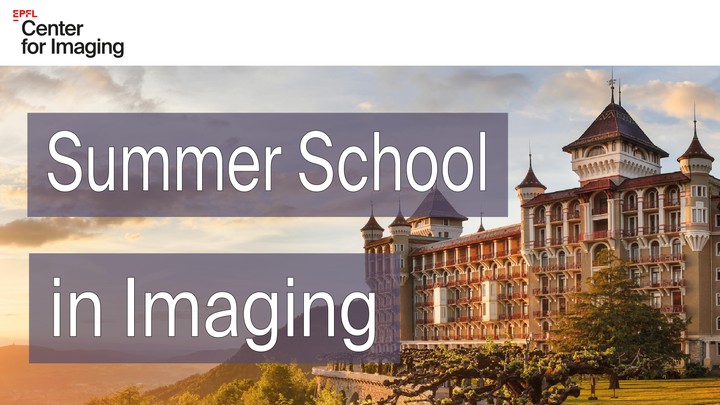
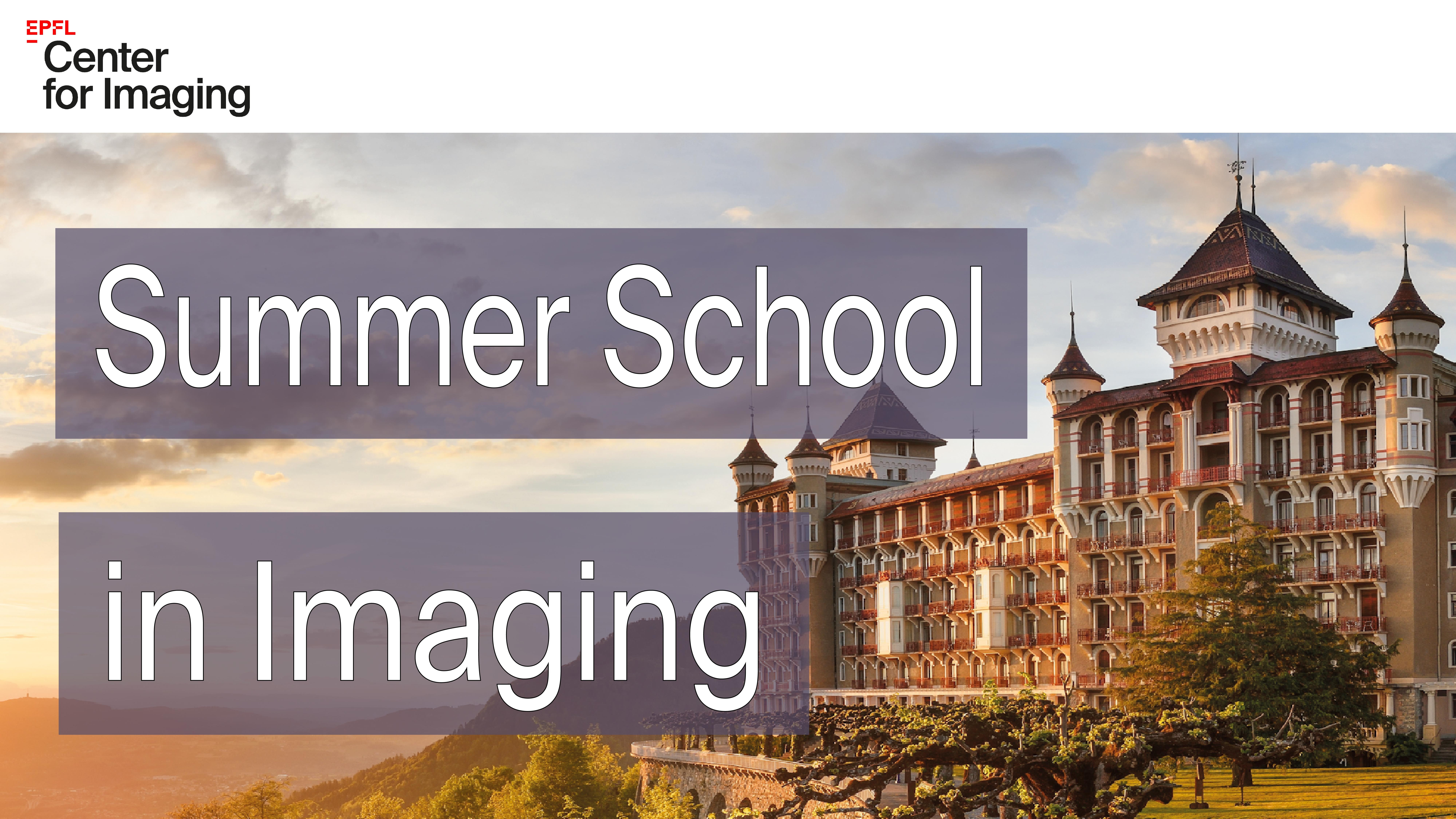
            "description": "<p>A hands-on introduction to the key concepts in image analysis for your everyday research! <br>\r\n<br>\r\nOpen to PhD students from all doctoral programs at EPFL, Swiss academic institutions and ETH domain.<br>\r\n<br>\r\n<strong>June 8 to 12 2026 </strong><br>\r\n<strong>Palace de Caux, Montreux</strong><br>\r\nPre-summer school Workshop will take place on June 4, 2026 (afternoon)<br>\r\n<br>\r\n<strong><a href=\"https://imaging.epfl.ch/summer-school\">More info</a></strong><br>\r\n<strong><a href=\"https://docs.google.com/forms/d/e/1FAIpQLSdtHQLlAolAnXJHI5BKbgJXUJA5F6seAPbIOT7W1zKvkZ90wQ/viewform?usp=header\">Application</a></strong> Deadline: March 1, 2026<br>\r\n<br>\r\nAre you a PhD student at EPFL, at another swiss academic institution or within the ETH domaine who regularly faces questions regarding the analysis of your images ? Do you want to learn more about practical concepts and tools to help you in this endeavor? Then our summer school in image analysis is for you! Throughout the week, a series of lectures will provide you with the essential concepts in image analysis – from the nature of digital images through the physics of image acquisition to the basics of deep learning, and more. In addition to these lectures, you will learn to use some popular image-analysis software during practical sessions.</p>",
            "image_description": "",
            "creation_date": "2026-02-03T09:47:28",
            "last_modification_date": "2026-02-03T10:01:52",
            "link_label": "Summer School in Imaging",
            "link_url": "https://imaging.epfl.ch/summer-school",
            "canceled": "False",
            "cancel_reason": "",
            "place_and_room": "Palace de Caux, Montreux",
            "url_place_and_room": "",
            "url_online_room": "",
            "spoken_languages": [
                "https://memento.epfl.ch/api/v1/spoken_languages/2/?format=api"
            ],
            "speaker": "",
            "organizer": "<a href=\"https://imaging.epfl.ch/\">Center for Imaging</a>",
            "contact": "[email protected]",
            "is_internal": "False",
            "theme": "",
            "vulgarization": {
                "id": 2,
                "fr_label": "Public averti",
                "en_label": "Informed public"
            },
            "registration": {
                "id": 1,
                "fr_label": "Sur inscription",
                "en_label": "Registration required"
            },
            "keywords": "",
            "file": null,
            "icalendar_url": "https://memento.epfl.ch/event/export/119553/",
            "category": {
                "id": 1,
                "code": "CONF",
                "fr_label": "Conférences - Séminaires",
                "en_label": "Conferences - Seminars",
                "activated": true
            },
            "academic_calendar_category": null,
            "domains": [],
            "mementos": [
                "https://memento.epfl.ch/api/v1/mementos/1/?format=api",
                "https://memento.epfl.ch/api/v1/mementos/4/?format=api",
                "https://memento.epfl.ch/api/v1/mementos/5/?format=api",
                "https://memento.epfl.ch/api/v1/mementos/6/?format=api",
                "https://memento.epfl.ch/api/v1/mementos/8/?format=api",
                "https://memento.epfl.ch/api/v1/mementos/9/?format=api",
                "https://memento.epfl.ch/api/v1/mementos/284/?format=api",
                "https://memento.epfl.ch/api/v1/mementos/27/?format=api"
            ]
        },
        {
            "id": 70903,
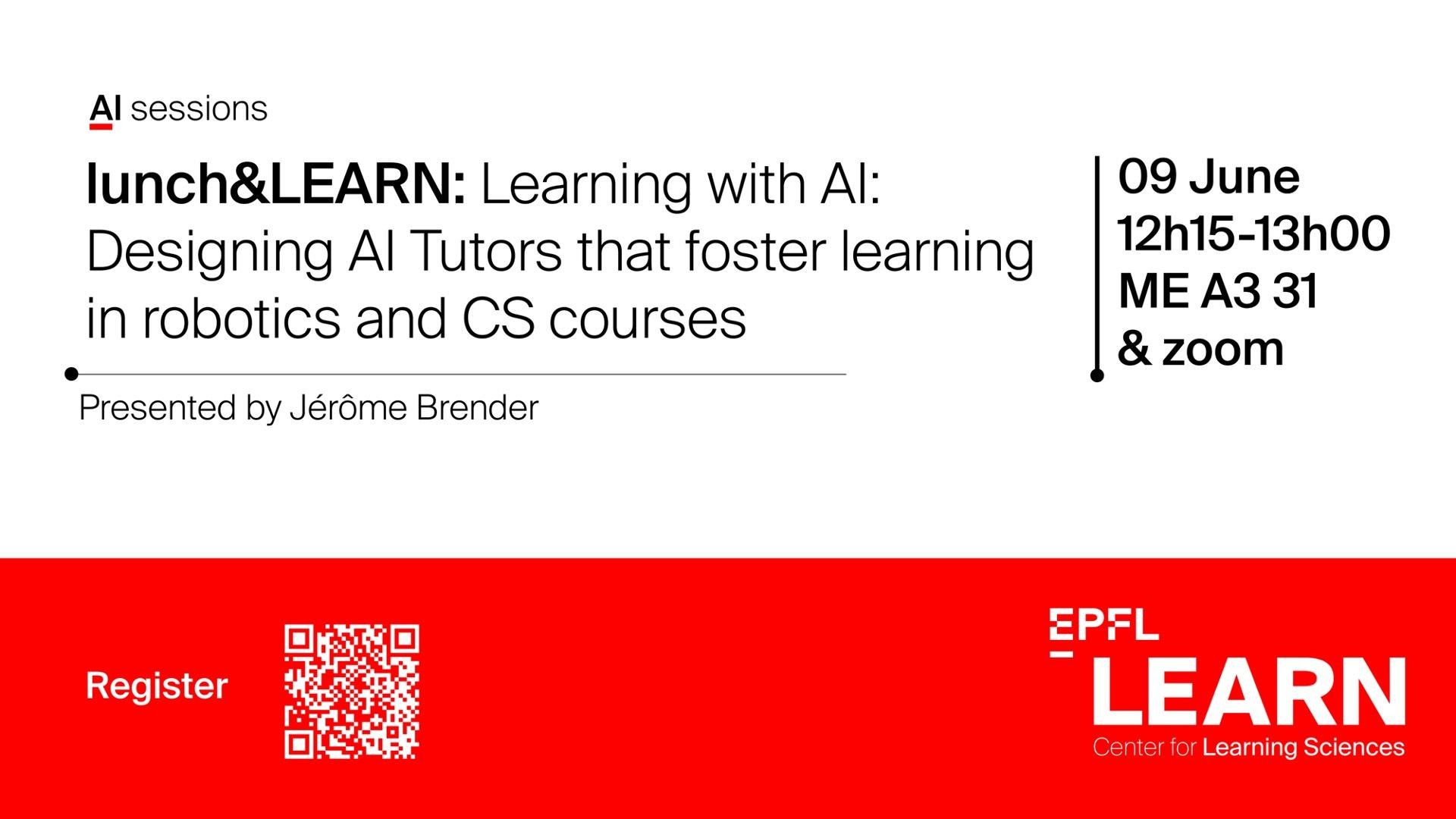
            "title": "lunch&LEARN:  Learning with AI: Designing AI Tutors that foster learning in robotics and CS courses",
            "slug": "lunchlearn-learning-with-ai-designing-ai-tutors-th",
            "event_url": "https://memento.epfl.ch/event/lunchlearn-learning-with-ai-designing-ai-tutors-th",
            "visual_url": "https://memento.epfl.ch/image/32313/200x112.jpg",
            "visual_large_url": "https://memento.epfl.ch/image/32313/720x405.jpg",
            "visual_maxsize_url": "https://memento.epfl.ch/image/32313/max-size.jpg",
            "lang": "en",
            "start_date": "2026-06-09",
            "end_date": "2026-06-09",
            "start_time": "12:15:00",
            "end_time": "13:00:00",
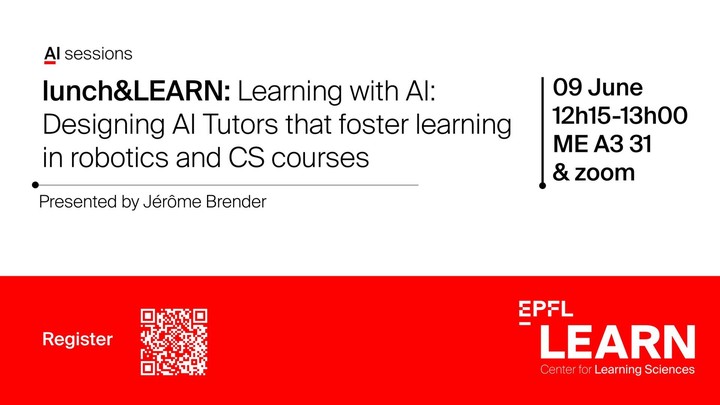
            "description": "<strong>// NEW DATE // This event has been rescheduled from 17 March to 9 June 2026!</strong><br>\r\n<br>\r\nHow can AI tutors be designed to support learning rather than shortcutting it?<br>\r\n<br>\r\nIn this presentation, Jérôme Brender (EPFL) will examine how undergraduate students learn with AI tutors in robotics and computer science courses.<br>\r\n<br>\r\nAcross multiple design iterations, he investigated how features such as course-grounded retrieval (RAG), Socratic questioning, and real-time prompt feedback, and debate chatbot, shape students’ engagement, prompting behavior, and learning outcomes.<br>\r\n<br>\r\nHis work focuses on how AI tutors can help students better understand course concepts and become more reflective and effective users of AI tools. The findings provide insights into designing AI tutors that foster critical thinking and support sustainable learning practices.",
            "image_description": "",
            "creation_date": "2026-01-21T13:49:42",
            "last_modification_date": "2026-03-10T14:15:23",
            "link_label": "Registration/zoom",
            "link_url": "https://epfl.zoom.us/meeting/register/4V57FBxZR-uhyymvvps-6g",
            "canceled": "False",
            "cancel_reason": "",
            "place_and_room": "ME B1 10",
            "url_place_and_room": "https://plan.epfl.ch/?room==ME%20B1%2010",
            "url_online_room": "https://epfl.zoom.us/meeting/register/4V57FBxZR-uhyymvvps-6g",
            "spoken_languages": [
                "https://memento.epfl.ch/api/v1/spoken_languages/2/?format=api"
            ],
            "speaker": "<a href=\"https://people.epfl.ch/jerome.brender?lang=en\">Jérôme Brender</a>",
            "organizer": "Center LEARN",
            "contact": "[email protected]",
            "is_internal": "True",
            "theme": "",
            "vulgarization": {
                "id": 2,
                "fr_label": "Public averti",
                "en_label": "Informed public"
            },
            "registration": {
                "id": 1,
                "fr_label": "Sur inscription",
                "en_label": "Registration required"
            },
            "keywords": "lunch&LEARN, Center LEARN, teaching, learning",
            "file": null,
            "icalendar_url": "https://memento.epfl.ch/event/export/119400/",
            "category": {
                "id": 1,
                "code": "CONF",
                "fr_label": "Conférences - Séminaires",
                "en_label": "Conferences - Seminars",
                "activated": true
            },
            "academic_calendar_category": null,
            "domains": [],
            "mementos": [
                "https://memento.epfl.ch/api/v1/mementos/416/?format=api",
                "https://memento.epfl.ch/api/v1/mementos/1/?format=api",
                "https://memento.epfl.ch/api/v1/mementos/3/?format=api",
                "https://memento.epfl.ch/api/v1/mementos/5/?format=api",
                "https://memento.epfl.ch/api/v1/mementos/6/?format=api",
                "https://memento.epfl.ch/api/v1/mementos/323/?format=api",
                "https://memento.epfl.ch/api/v1/mementos/8/?format=api",
                "https://memento.epfl.ch/api/v1/mementos/85/?format=api",
                "https://memento.epfl.ch/api/v1/mementos/65/?format=api",
                "https://memento.epfl.ch/api/v1/mementos/27/?format=api",
                "https://memento.epfl.ch/api/v1/mementos/417/?format=api"
            ]
        },
        {
            "id": 70949,
            "title": "Complex Fluids at Interfaces: Structure, Stability, and Molecular Effects",
            "slug": "complex-fluids-at-interfaces-structure-stability-a",
            "event_url": "https://memento.epfl.ch/event/complex-fluids-at-interfaces-structure-stability-a",
            "visual_url": "https://memento.epfl.ch/image/32337/200x112.jpg",
            "visual_large_url": "https://memento.epfl.ch/image/32337/720x405.jpg",
            "visual_maxsize_url": "https://memento.epfl.ch/image/32337/max-size.jpg",
            "lang": "en",
            "start_date": "2026-06-17",
            "end_date": "2026-06-19",
            "start_time": null,
            "end_time": null,
            "description": "<p>You can apply to participate and find all the relevant information (speakers, abstracts, program,...) on the event website: <a href=\"https://www.cecam.org/workshop-details/complex-fluids-at-interfaces-structure-stability-and-molecular-effects-1492\">https://www.cecam.org/workshop-details/complex-fluids-at-interfaces-structure-stability-and-molecular-effects-1492</a>.<br>\r\n<br>\r\nRegistration is required to attend the full event, take part in the social activities and present a poster at the poster session (if any).  However, the EPFL community is welcome to attend specific lectures without registration if the topic is of interest to their research. Do not hesitate to contact the <a href=\"mailto:[email protected]\">CECAM Event Manager</a> if you have any question.<br>\r\n<br>\r\n<strong>Description</strong><br>\r\n<br>\r\nComplex fluids are ubiquitous in biology, geophysics, and industry [1]. These materials are challenging to characterize and predict [1–4], particularly when they incorporate multiple interfaces, as in colloidal suspensions [4], foams [5–7], or nanoporous membranes [8–10]. Many of these interfaces are micro- or nano-scale and evolve over short times, which can obscure them to observation and pose challenges to experimentalists [2–5, 11, 12]. This opens exciting opportunities for a strong partnership between the development of novel theoretical, computational, and experimental techniques.<br>\r\nProbing interfaces presents unique challenges compared to probing complex fluids in the bulk. The interfacial structure and constitutive behavior then depend on the composition of two fluids as well as the interfacial configuration [13, 14]. Translating this increased complexity to a computational framework involves developing reliable models describing molecular interactions near fluid-fluid or fluid-solid interfaces [15–17], as well as models for continuum stresses [18]. Molecular modeling is necessary to reveal the physics of chemically-complex structures [17], but is computationally expensive, and it can be challenging to identify the relevant physics to include [19]. Yet the interface also provides unique opportunities for control: in liquid crystals, for example, interfacial stresses can be transmitted through the bulk, leading to novel pattern formation [20] and optical materials exploiting interfacial control [21]. Finally, interfaces are prone to instabilities, which can make flows unpredictable, but opens opportunities to exploit unstable growth for spontaneous patterning.<br>\r\nTo underscore the present challenges, even for a “simple” Newtonian fluid, the presence of an interface may hinder understanding of flow mechanics. For example, mechanisms for contact during drop impact are still debated [22]: molecular dynamics (MD) simulations can clarify which effects dominate among interfacial instabilities, electrostatic charge, gas-kinetic effects, and other driving forces [22–26], in addition to liquid/surface chemistry [27, 28]. Diffusive processes at interfaces [29] and nanoscale membrane flows, where osmotic and phoretic effects are significant [11, 30], also require further development in MD or coarse-grained models.<br>\r\n <br>\r\n<strong>This workshop aims to foster exchanges around the following </strong><strong>broad questions:</strong>\r\n</p><ul>\r\n\t<li>How do <strong>molecular phenomena</strong><strong> </strong>determine the <strong>structural properties and interfacial dynamics </strong>of complex fluid interfaces?</li>\r\n\t<li>How do we approach <strong>a rigorous, robust, and predictive upscaling </strong>between non-continuum computational approaches (e.g. MD, coarse-grained models), which are computationally costly, and large-scale systems? Can we extract universal quantities or concepts from MD to be used in a continuum model? Are these potential quantities intrinsic properties or do they depend on the flow configuration and hence require an ad hoc calibration for each flow situation?</li>\r\n\t<li><strong>How can emerging experimental and computational techniques inform our understanding of </strong><strong>interfacial instabilities in complex fluids? </strong>Can we account for instabilities arising from molecular and meso-scales in a macroscopic stability analysis?</li>\r\n\t<li>Is it possible to <strong>incorporate microscopic effects into macroscopic models </strong>which 'go beyond' the conventional Navier-Stokes-Fourier paradigm? For example, can effective viscosities adequately account for molecular effects, or can noise terms incorporate thermal fluctuations? Can these models be captured by extending existing computational approaches, or do they require entirely new frameworks?</li>\r\n</ul>\r\n<strong>The list of confirmed speakers will be announced in February. </strong>In addition, a limited number of abstracts may be submitted for the poster session – submissions will open in February.<br>\r\n<br>\r\n<strong>References</strong><br>\r\n<br>\r\n<a href=\"https://doi.org/10.1021/acs.langmuir.3c03727\" target=\"_blank\">[1] L. Veldscholte, J. Snoeijer, W. den Otter, S. de Beer, Langmuir, <strong>40</strong>, 4401-4409 (2024)</a><br>\r\n<a href=\"https://doi.org/10.1017/jfm.2023.659\" target=\"_blank\">[2] G. Zampogna, P. Ledda, K. Wittkowski, F. Gallaire, J. Fluid Mech., <strong>970</strong>, A39 (2023)</a><br>\r\n<a href=\"https://doi.org/10.1103/physrevlett.134.054001\" target=\"_blank\">[3] A. Carbonaro, G. Savorana, L. Cipelletti, R. Govindarajan, D. Truzzolillo, Phys. Rev. Lett., <strong>134</strong>, 054001 (2025)</a><br>\r\n<a href=\"https://doi.org/10.1002/adma.202502173\" target=\"_blank\">[4] L. Buonaiuto, S. Reuvekamp, B. Shakhayeva, E. Liu, F. Neuhaus, B. Braunschweig, S. de Beer, F. Mugele, Advanced Materials, <strong>37</strong>, (2025)</a><br>\r\n<a href=\"https://doi.org/10.1021/acs.jpcb.4c02513\" target=\"_blank\">[5] J. Sun, L. Li, R. Zhang, H. Jing, R. Hao, Z. Li, Q. Xiao, L. Zhang, J. Phys. Chem. B, <strong>128</strong>, 7871-7881 (2024)</a><br>\r\n<a href=\"https://doi.org/10.1063/5.0205314\" target=\"_blank\">[6] H. Liu, J. Zhang, Physics of Fluids, <strong>36</strong>, (2024)</a><br>\r\n<a href=\"https://doi.org/10.1103/physrevlett.131.164001\" target=\"_blank\">[7] S. Perumanath, M. Chubynsky, R. Pillai, M. Borg, J. Sprittles, Phys. Rev. Lett., <strong>131</strong>, 164001 (2023)</a><br>\r\n<a href=\"https://doi.org/10.1103/physrevlett.134.134001\" target=\"_blank\">[8] F. Yu, A. Ratschow, R. Tao, X. Li, Y. Jin, J. Wang, Z. Wang, Phys. Rev. Lett., <strong>134</strong>, 134001 (2025)</a><br>\r\n<a href=\"https://doi.org/10.1103/physrevfluids.8.103602\" target=\"_blank\">[9] R. Kaviani, J. Kolinski, Phys. Rev. Fluids, <strong>8</strong>, 103602 (2023)</a><br>\r\n<a href=\"https://doi.org/10.1146/annurev-fluid-121021-021121\" target=\"_blank\">[10] J. Sprittles, Annu. Rev. Fluid Mech., <strong>56</strong>, 91-118 (2024)</a><br>\r\n<a href=\"https://doi.org/10.1038/s41377-022-00930-5\" target=\"_blank\">[11] L. Ma, C. Li, J. Pan, Y. Ji, C. Jiang, R. Zheng, Z. Wang, Y. Wang, B. Li, Y. Lu, Light. Sci. Appl., <strong>11</strong>, 270 (2022)</a><br>\r\n<a href=\"https://doi.org/10.1038/s41467-023-43978-6\" target=\"_blank\">[12] Q. Zhang, W. Wang, S. Zhou, R. Zhang, I. Bischofberger, Nat. Commun., <strong>15</strong>, 7 (2024)</a><br>\r\n<a href=\"https://doi.org/10.1039/d4cc01557f\" target=\"_blank\">[13] R. Ishraaq, S. Das, Chem. Commun., <strong>60</strong>, 6093-6129 (2024)</a><br>\r\n<a href=\"https://doi.org/10.1146/annurev-fluid-122316-045034\" target=\"_blank\">[14] S. Popinet, Annu. Rev. Fluid Mech., <strong>50</strong>, 49-75 (2018)</a><br>\r\n<a href=\"https://doi.org/10.1039/d4cp02128b\" target=\"_blank\">[15] L. Smook, R. Ishraaq, T. Akash, S. de Beer, S. Das, Phys. Chem. Chem. Phys., <strong>26</strong>, 25557-25566 (2024)</a><br>\r\n<a href=\"https://doi.org/10.1146/annurev-fluid-031821-104935\" target=\"_blank\">[16] R. Ewoldt, C. Saengow, Annu. Rev. Fluid Mech., <strong>54</strong>, 413-441 (2022)</a><br>\r\n<a href=\"https://doi.org/10.1021/acsmacrolett.7b00812\" target=\"_blank\">[17] H. Liang, Z. Cao, Z. Wang, A. Dobrynin, ACS Macro Lett., <strong>7</strong>, 116-121 (2018)</a><br>\r\n<a href=\"https://doi.org/10.1038/s41467-017-00636-y\" target=\"_blank\">[18] Q. Xu, K. Jensen, R. Boltyanskiy, R. Sarfati, R. Style, E. Dufresne, Nat. Commun., <strong>8</strong>, 555 (2017)</a><br>\r\n<a href=\"https://doi.org/10.1103/physreve.111.055103\" target=\"_blank\">[19] A. Fukushima, S. Oyagi, T. Tokumasu, Phys. Rev. E, <strong>111</strong>, 055103 (2025)</a><br>\r\n<a href=\"https://doi.org/10.1088/1361-6501/ad66f9\" target=\"_blank\">[20] K. Jorissen, L. Veldscholte, M. Odijk, S. de Beer, Meas. Sci. Technol., <strong>35</strong>, 115501 (2024)</a><br>\r\n<a href=\"https://doi.org/10.1073/pnas.2221304120\" target=\"_blank\">[21] A. Allemand, M. Zhao, O. Vincent, R. Fulcrand, L. Joly, C. Ybert, A. Biance, Proc. Natl. Acad. Sci. U.S.A., <strong>120</strong>, (2023)</a><br>\r\n<a href=\"https://doi.org/10.1146/annurev-fluid-071320-095958\" target=\"_blank\">[22] N. Kavokine, R. Netz, L. Bocquet, Annu. Rev. Fluid Mech., <strong>53</strong>, 377-410 (2021)</a><br>\r\n<a href=\"https://doi.org/10.1038/s41563-020-0625-8\" target=\"_blank\">[23] L. Bocquet, Nat. Mater., <strong>19</strong>, 254-256 (2020)</a><br>\r\n<a href=\"https://doi.org/10.1126/science.aan2438\" target=\"_blank\">[24] R. Tunuguntla, R. Henley, Y. Yao, T. Pham, M. Wanunu, A. Noy, Science, <strong>357</strong>, 792-796 (2017)</a><br>\r\n<a href=\"https://doi.org/10.1073/pnas.1705181114\" target=\"_blank\">[25] P. Beltramo, M. Gupta, A. Alicke, I. Liascukiene, D. Gunes, C. Baroud, J. Vermant, Proc. Natl. Acad. Sci. U.S.A., <strong>114</strong>, 10373-10378 (2017)</a><br>\r\n<a href=\"https://doi.org/10.1103/physrevlett.133.088202\" target=\"_blank\">[26] C. Guidolin, E. Rio, R. Cerbino, F. Giavazzi, A. Salonen, Phys. Rev. Lett., <strong>133</strong>, 088202 (2024)</a><br>\r\n<a href=\"https://doi.org/10.1017/jfm.2021.529\" target=\"_blank\">[27] A. Bussonnière, I. Cantat, J. Fluid Mech., <strong>922</strong>, A25 (2021)</a><br>\r\n<a href=\"https://doi.org/10.1103/physreve.95.030602\" target=\"_blank\">[28] L. Oyarte Gálvez, S. de Beer, D. van der Meer, A. Pons, Phys. Rev. E, <strong>95</strong>, 030602 (2017)</a><br>\r\n<a href=\"https://doi.org/10.1021/acs.macromol.4c01604\" target=\"_blank\">[29] V. Calabrese, A. Shen, S. Haward, Macromolecules, <strong>57</strong>, 9668-9676 (2024)</a><br>\r\n<a href=\"https://doi.org/10.1073/pnas.2211347120\" target=\"_blank\">[30] M. Kumar, J. Guasto, A. Ardekani, Proc. Natl. Acad. Sci. U.S.A., <strong>120</strong>, (2023)</a><br>\r\n ",
            "image_description": "",
            "creation_date": "2026-01-26T14:11:21",
            "last_modification_date": "2026-01-26T16:41:44",
            "link_label": "Complex Fluids at Interfaces: Structure, Stability, and Molecular Effects",
            "link_url": "https://www.cecam.org/workshop-details/complex-fluids-at-interfaces-structure-stability-and-molecular-effects-1492",
            "canceled": "False",
            "cancel_reason": "",
            "place_and_room": "BCH 2103",
            "url_place_and_room": "https://plan.epfl.ch/?room==BCH%202103",
            "url_online_room": "",
            "spoken_languages": [
                "https://memento.epfl.ch/api/v1/spoken_languages/2/?format=api"
            ],
            "speaker": "",
            "organizer": "<strong>Irmgard Bischofberger, </strong>MIT ; <strong>Lebo Molefe, </strong>EPFL ; <strong>James Sprittles, </strong>University of Warwick ; <strong>Giuseppe Zampogna, </strong>Università degli Studi di Genov",
            "contact": "<a href=\"mailto:[email protected]\"><strong>Cornelia Bujenita</strong></a>, CECAM Events and Operations Manager",
            "is_internal": "False",
            "theme": "",
            "vulgarization": {
                "id": 2,
                "fr_label": "Public averti",
                "en_label": "Informed public"
            },
            "registration": {
                "id": 1,
                "fr_label": "Sur inscription",
                "en_label": "Registration required"
            },
            "keywords": "",
            "file": null,
            "icalendar_url": "https://memento.epfl.ch/event/export/119438/",
            "category": {
                "id": 1,
                "code": "CONF",
                "fr_label": "Conférences - Séminaires",
                "en_label": "Conferences - Seminars",
                "activated": true
            },
            "academic_calendar_category": null,
            "domains": [],
            "mementos": [
                "https://memento.epfl.ch/api/v1/mementos/1/?format=api",
                "https://memento.epfl.ch/api/v1/mementos/5/?format=api",
                "https://memento.epfl.ch/api/v1/mementos/6/?format=api",
                "https://memento.epfl.ch/api/v1/mementos/8/?format=api",
                "https://memento.epfl.ch/api/v1/mementos/27/?format=api"
            ]
        },
        {
            "id": 70950,
            "title": "Theoretical Realisation of Quantum Phenomena In Computational Materials Discovery",
            "slug": "theoretical-realisation-of-quantum-phenomena-in--2",
            "event_url": "https://memento.epfl.ch/event/theoretical-realisation-of-quantum-phenomena-in--2",
            "visual_url": "https://memento.epfl.ch/image/32338/200x112.jpg",
            "visual_large_url": "https://memento.epfl.ch/image/32338/720x405.jpg",
            "visual_maxsize_url": "https://memento.epfl.ch/image/32338/max-size.jpg",
            "lang": "en",
            "start_date": "2026-06-22",
            "end_date": "2026-06-24",
            "start_time": null,
            "end_time": null,
            "description": "<p>You can apply to participate and find all the relevant information (speakers, abstracts, program,...) on the event website: <a href=\"https://www.cecam.org/workshop-details/theoretical-realisation-of-quantum-phenomena-in-computational-materials-discovery-1485\">https://www.cecam.org/workshop-details/theoretical-realisation-of-quantum-phenomena-in-computational-materials-discovery-1485</a>.<br>\r\n<br>\r\nRegistration is required to attend the full event, take part in the social activities and present a poster at the poster session (if any).  However, the EPFL community is welcome to attend specific lectures without registration if the topic is of interest to their research. Do not hesitate to contact the <a href=\"mailto:[email protected]\">CECAM Event Manager</a> if you have any question.<br>\r\n<br>\r\n<strong>Description</strong><br>\r\n<br>\r\nQuantum phenomena in materials underpin a range of emerging technologies, including spin-based quantum technologies, efficient energy transport materials and ultra-narrow bandwidth lasers.<sup>1,2,3</sup> Emergent behaviour such as quantum magnetism, superconductivity and superradiance<sup>4</sup> arise from the complex interplay between electronic and structural properties; electronic features including strong electron correlation, spin-orbit coupling and reduced dimensionality can lead to phenomena such as unconventional superconductivity and room-temperature spin coherences, whilst structural factors such as crystal symmetry, doping concentrations and Moiré twist patterns are pivotal in shaping these quantum characteristics.<sup>5,6</sup> Computational quantum materials discovery requires both highly advanced theoretical models of the electronic structure and high-throughput approaches for identifying stable crystal structures and predicting their properties.<sup>3,7</sup><br>\r\nStrongly correlated electrons, ubiquitous in quantum materials, challenge conventional density functional theory (DFT). Quantum embedding methods, such as Density Matrix Embedding Theory (DMET) and Quantum Defect Embedding Theory (QDET), are powerful tools for describing strongly correlated electronic states in materials. QDET solves an effective Hamiltonian for a strongly-correlated subset of DFT orbitals using full configuration interaction, parameterized via a Green's function approach.<sup>8</sup> DMET, however, maps the solid-state problem onto a self-consistent quantum impurity coupled to a mean-field bath, with the impurity solved by high-level methods.<sup>9</sup> The application of these advanced techniques is rapidly growing, from analysing superconducting cuprates to describing quantum spin defects in semiconductors.<sup>8,9</sup><br>\r\nModel Hamiltonians, such as the multi-band Hubbard model, are increasingly used to describe the low-energy physics of quantum materials.<sup>10</sup> While the constrained random phase approximation is the traditional choice for parametrising these models,<sup>11</sup> the newly developed moment-conserved RPA may offer superior accuracy by conserving instantaneous two-point correlation functions.<sup>12,13</sup> Powerful numerical techniques like Determinant Quantum Monte Carlo have recently been pioneered for solving the model Hamiltonian and predicting quantum phenomena such as pairing susceptibilities.<sup>14</sup><br>\r\nSuch theoretical methods are also essential for computational discovery of spin defects in semiconductors, a promising platform for room-temperature qubits.<sup>3,15</sup> Advanced theoretical treatments are essential to predict defect electronic, magnetic, and optical properties, incorporating effects like spin-orbit and spin-phonon coupling which determine spin coherence and optical manipulation characteristics. The current state-of-the-art combines DFT studies of semiconductor bulk properties with ab initio treatments of the defect; quantum embedding methods are emerging as a promising alternative.<sup>16,17</sup><br>\r\nGiven the immense diversity of materials, high-throughput screening is a cornerstone of modern materials discovery. DFT, particularly with state-of-the-art approximations like r2SCAN+rVV10, remains the workhorse for reliably determining material structures; such calculations often offer critical insight into both a systems stability and electronic structure.<sup>7,18,19,20</sup> Machine learning (ML) is transforming materials discovery by slashing the computational cost of such calculations, allowing a wider exploration of composition space.<sup>21,22</sup><br>\r\nComputational quantum materials modelling is advancing rapidly, however reconciling methods treating strongly correlated electrons with computational workflows employed in modern materials discovery remains relatively unexploited. The synergy of advanced theory, high-performance computing and ML has the potential to drive breakthroughs in quantum materials discovery and accelerate development of emerging technologies, from novel qubit platforms to room-temperature superconductors.<br>\r\n<br>\r\n<strong>References</strong><br>\r\n<br>\r\n<a href=\"https://doi.org/10.1103/physrevlett.132.076401\" target=\"_blank\">[1] C. Scott, G. Booth, Phys. Rev. Lett., <strong>132</strong>, 076401 (2024)</a><br>\r\n<a href=\"https://doi.org/10.1038/s41524-025-01554-0\" target=\"_blank\">[2] X. Jiang, W. Wang, S. Tian, H. Wang, T. Lookman, Y. Su, npj. Comput. Mater., <strong>11</strong>, 79 (2025)</a><br>\r\n<a href=\"https://doi.org/10.1016/j.triboint.2024.110438\" target=\"_blank\">[3] S. Giaremis, M. Righi, Tribology International, <strong>204</strong>, 110438 (2025)</a><br>\r\n<a href=\"https://doi.org/10.1038/s41524-024-01437-w\" target=\"_blank\">[4] Z. Zhu, J. Park, H. Sahasrabuddhe, A. Ganose, R. Chang, J. Lawson, A. Jain, npj. Comput. Mater., <strong>10</strong>, 258 (2024)</a><br>\r\n<a href=\"https://doi.org/10.1002/jcc.26353\" target=\"_blank\">[5] R. Nelson, C. Ertural, J. George, V. Deringer, G. Hautier, R. Dronskowski, J. Comput. Chem., <strong>41</strong>, 1931-1940 (2020)</a><br>\r\n<a href=\"https://doi.org/10.1021/acsmaterialsau.2c00059\" target=\"_blank\">[6] M. Kothakonda, A. Kaplan, E. Isaacs, C. Bartel, J. Furness, J. Ning, C. Wolverton, J. Perdew, J. Sun, ACS Mater. Au, <strong>3</strong>, 102-111 (2022)</a><br>\r\n<a href=\"https://doi.org/10.1038/s41524-025-01547-z\" target=\"_blank\">[7] V. Briganti, A. Lunghi, npj. Comput. Mater., <strong>11</strong>, 62 (2025)</a><br>\r\n<a href=\"https://doi.org/10.1021/acs.jpclett.5c00355\" target=\"_blank\">[8] A. Kundu, F. Martinelli, G. Galli, J. Phys. Chem. Lett., <strong>16</strong>, 1973-1979 (2025)</a><br>\r\n<a href=\"https://doi.org/10.1557/s43577-023-00659-5\" target=\"_blank\">[9] A. Gali, A. Schleife, A. Heinrich, A. Laucht, B. Schuler, C. Chakraborty, C. Anderson, C. Déprez, J. McCallum, L. Bassett, M. Friesen, M. Flatté, P. Maurer, S. Coppersmith, T. Zhong, V. Begum-Hudde, Y. Ping, MRS Bulletin, <strong>49</strong>, 256-276 (2024)</a><br>\r\n<a href=\"https://doi.org/10.1073/pnas.2408717121\" target=\"_blank\">[10] P. Mai, B. Cohen-Stead, T. Maier, S. Johnston, Proc. Natl. Acad. Sci. U.S.A., <strong>121</strong>, (2024)</a><br>\r\n<a href=\"https://doi.org/10.1103/physrevb.108.064511\" target=\"_blank\">[11] C. Pellegrini, C. Kukkonen, A. Sanna, Phys. Rev. B, <strong>108</strong>, 064511 (2023)</a><br>\r\n<a href=\"https://doi.org/10.1186/s40712-024-00202-7\" target=\"_blank\">[12] R. Goyal, S. Maharaj, P. Kumar, M. Chandrasekhar, J Mater. Sci: Mater Eng., <strong>20</strong>, 4 (2025)</a><br>\r\n<a href=\"https://doi.org/10.1038/s41524-024-01314-6\" target=\"_blank\">[13] Y. Chang, E. van Loon, B. Eskridge, B. Busemeyer, M. Morales, C. Dreyer, A. Millis, S. Zhang, T. Wehling, L. Wagner, M. Rösner, npj. Comput. Mater., <strong>10</strong>, 129 (2024)</a><br>\r\n<a href=\"https://doi.org/10.1103/physrevx.15.021049\" target=\"_blank\">[14] H. Padma, J. Thomas, S. TenHuisen, W. He, Z. Guan, J. Li, B. Lee, Y. Wang, S. Lee, Z. Mao, H. Jang, V. Bisogni, J. Pelliciari, M. Dean, S. Johnston, M. Mitrano, Phys. Rev. X, <strong>15</strong>, 021049 (2025)</a><br>\r\n<a href=\"https://doi.org/10.1038/s41467-025-56883-x\" target=\"_blank\">[15] Z. Cui, J. Yang, J. Tölle, H. Ye, S. Yuan, H. Zhai, G. Park, R. Kim, X. Zhang, L. Lin, T. Berkelbach, G. Chan, Nat. Commun., <strong>16</strong>, 1845 (2025)</a><br>\r\n<a href=\"https://doi.org/10.1021/acs.jpclett.5c00287\" target=\"_blank\">[16] L. Otis, Y. Jin, V. Yu, S. Chen, L. Gagliardi, G. Galli, J. Phys. Chem. Lett., <strong>16</strong>, 3092-3099 (2025)</a><br>\r\n<a href=\"https://doi.org/10.1039/d5dd00019j\" target=\"_blank\">[17] A. Ganose, H. Sahasrabuddhe, M. Asta, K. Beck, T. Biswas, A. Bonkowski, J. Bustamante, X. Chen, Y. Chiang, D. Chrzan, J. Clary, O. Cohen, C. Ertural, M. Gallant, J. George, S. Gerits, R. Goodall, R. Guha, G. Hautier, M. Horton, T. Inizan, A. Kaplan, R. Kingsbury, M. Kuner, B. Li, X. Linn, M. McDermott, R. Mohanakrishnan, A. Naik, J. Neaton, S. Parmar, K. Persson, G. Petretto, T. Purcell, F. Ricci, B. Rich, J. Riebesell, G. Rignanese, A. Rosen, M. Scheffler, J. Schmidt, J. Shen, A. Sobolev, R. Sundararaman, C. Tezak, V. Trinquet, J. Varley, D. Vigil-Fowler, D. Wang, D. Waroquiers, M. Wen, H. Yang, H. Zheng, J. Zheng, Z. Zhu, A. Jain, Digital Discovery, (2025)</a><br>\r\n<a href=\"https://doi.org/10.1002/adma.202106909\" target=\"_blank\">[18] W. Ko, Z. Gai, A. Puretzky, L. Liang, T. Berlijn, J. Hachtel, K. Xiao, P. Ganesh, M. Yoon, A. Li, Advanced Materials, <strong>35</strong>, (2022)</a><br>\r\n<a href=\"https://doi.org/10.1126/science.adg0014\" target=\"_blank\">[19] L. Du, M. Molas, Z. Huang, G. Zhang, F. Wang, Z. Sun, Science, <strong>379</strong>, (2023)</a><br>\r\n<a href=\"https://doi.org/10.1038/s41586-023-07001-8\" target=\"_blank\">[20] C. Zhu, S. Boehme, L. Feld, A. Moskalenko, D. Dirin, R. Mahrt, T. Stöferle, M. Bodnarchuk, A. Efros, P. Sercel, M. Kovalenko, G. Rainò, Nature, <strong>626</strong>, 535-541 (2024)</a><br>\r\n<a href=\"https://doi.org/10.1515/nanoph-2022-0723\" target=\"_blank\">[21] Á. Gali, Nanophotonics, <strong>12</strong>, 359-397 (2023)</a><br>\r\n<a href=\"https://doi.org/10.3389/fmats.2024.1343005\" target=\"_blank\">[22] V. Harris, P. Andalib, Front. Mater., <strong>11</strong>, (2024)</a></p>",
            "image_description": "",
            "creation_date": "2026-01-26T14:46:04",
            "last_modification_date": "2026-01-26T16:42:30",
            "link_label": "Theoretical Realisation of Quantum Phenomena In Computational Materials Discovery",
            "link_url": "https://www.cecam.org/workshop-details/theoretical-realisation-of-quantum-phenomena-in-computational-materials-discovery-1485",
            "canceled": "False",
            "cancel_reason": "",
            "place_and_room": "BCH 2103",
            "url_place_and_room": "https://plan.epfl.ch/?room==BCH%202103",
            "url_online_room": "",
            "spoken_languages": [
                "https://memento.epfl.ch/api/v1/spoken_languages/2/?format=api"
            ],
            "speaker": "",
            "organizer": "<strong>Petros-Panagis Filippatos, </strong>University of Nottingham ; <strong>Katherine Inzani, </strong>University of Nottingham ; <strong>Tom Irons, </strong>University of Nottingham ; <strong>Connor Williamson, </strong>University of Nottingham",
            "contact": "<a href=\"mailto:[email protected]\"><strong>Cornelia Bujenita</strong></a>, CECAM Events and Operations Manager",
            "is_internal": "False",
            "theme": "",
            "vulgarization": {
                "id": 2,
                "fr_label": "Public averti",
                "en_label": "Informed public"
            },
            "registration": {
                "id": 1,
                "fr_label": "Sur inscription",
                "en_label": "Registration required"
            },
            "keywords": "",
            "file": null,
            "icalendar_url": "https://memento.epfl.ch/event/export/119440/",
            "category": {
                "id": 1,
                "code": "CONF",
                "fr_label": "Conférences - Séminaires",
                "en_label": "Conferences - Seminars",
                "activated": true
            },
            "academic_calendar_category": null,
            "domains": [],
            "mementos": [
                "https://memento.epfl.ch/api/v1/mementos/1/?format=api",
                "https://memento.epfl.ch/api/v1/mementos/5/?format=api",
                "https://memento.epfl.ch/api/v1/mementos/6/?format=api",
                "https://memento.epfl.ch/api/v1/mementos/8/?format=api",
                "https://memento.epfl.ch/api/v1/mementos/27/?format=api"
            ]
        },
        {
            "id": 71427,
            "title": "Training \"Smart Publishing\"",
            "slug": "training-smart-publishing-5",
            "event_url": "https://memento.epfl.ch/event/training-smart-publishing-5",
            "visual_url": "https://memento.epfl.ch/image/32773/200x112.jpg",
            "visual_large_url": "https://memento.epfl.ch/image/32773/720x405.jpg",
            "visual_maxsize_url": "https://memento.epfl.ch/image/32773/max-size.jpg",
            "lang": "en",
            "start_date": "2026-06-23",
            "end_date": "2026-06-23",
            "start_time": "10:00:00",
            "end_time": "12:00:00",
            "description": "<div class=\"all_text\"><strong>Publishing to make your research available to the scientific community is a rewarding step. Do you want to understand how it works and know some tips that will help at the submission stage?</strong><br>\r\n<br>\r\nIn this workshop we will address the publication process in the current context:</div>\r\n\r\n<ul>\r\n\t<li>Become familiar with the context of scholarly communication and its latest developments.</li>\r\n\t<li>Understand the important steps leading to publication, including peer-review.</li>\r\n\t<li>Ensure your compliance towards EPFL and funders' Open Access policy.</li>\r\n\t<li>Know and protect your rights as an author according to EPFL’s policy.</li>\r\n\t<li>Get to understand what a publishing contract entails.</li>\r\n</ul>\r\n\r\n<div class=\"all_text\"><br>\r\n<a href=\"https://bookwhen.com/epfl_library/e/ev-s9xfp-20260317100000\">Registration</a><br>\r\n<br>\r\nMore information about <a href=\"https://www.epfl.ch/campus/library/training/\">EPFL Library Teaching offer</a></div>",
            "image_description": "CC-BY-NC-SA EPFL Library",
            "creation_date": "2026-03-23T11:31:08",
            "last_modification_date": "2026-03-23T11:32:38",
            "link_label": "Registration",
            "link_url": "https://bookwhen.com/fr/epfl_library/e/ev-smfzy-20260623100000",
            "canceled": "False",
            "cancel_reason": "",
            "place_and_room": "MED 0 1418",
            "url_place_and_room": "https://plan.epfl.ch/?room==MED%200%201418",
            "url_online_room": "",
            "spoken_languages": [
                "https://memento.epfl.ch/api/v1/spoken_languages/2/?format=api"
            ],
            "speaker": "EPFL Library Training Team",
            "organizer": "EPFL Library",
            "contact": "[email protected]",
            "is_internal": "False",
            "theme": "",
            "vulgarization": {
                "id": 1,
                "fr_label": "Tout public",
                "en_label": "General public"
            },
            "registration": {
                "id": 1,
                "fr_label": "Sur inscription",
                "en_label": "Registration required"
            },
            "keywords": "",
            "file": null,
            "icalendar_url": "https://memento.epfl.ch/event/export/120150/",
            "category": {
                "id": 15,
                "code": "FORM",
                "fr_label": "Formations internes",
                "en_label": "Internal trainings",
                "activated": true
            },
            "academic_calendar_category": null,
            "domains": [],
            "mementos": [
                "https://memento.epfl.ch/api/v1/mementos/1/?format=api",
                "https://memento.epfl.ch/api/v1/mementos/3/?format=api",
                "https://memento.epfl.ch/api/v1/mementos/4/?format=api",
                "https://memento.epfl.ch/api/v1/mementos/5/?format=api",
                "https://memento.epfl.ch/api/v1/mementos/6/?format=api",
                "https://memento.epfl.ch/api/v1/mementos/8/?format=api",
                "https://memento.epfl.ch/api/v1/mementos/275/?format=api",
                "https://memento.epfl.ch/api/v1/mementos/27/?format=api"
            ]
        },
        {
            "id": 70951,
            "title": "Toward Intelligent Behavior in Macroscopic Active Matter",
            "slug": "toward-intelligent-behavior-in-macroscopic-active",
            "event_url": "https://memento.epfl.ch/event/toward-intelligent-behavior-in-macroscopic-active",
            "visual_url": "https://memento.epfl.ch/image/32339/200x112.jpg",
            "visual_large_url": "https://memento.epfl.ch/image/32339/720x405.jpg",
            "visual_maxsize_url": "https://memento.epfl.ch/image/32339/max-size.jpg",
            "lang": "en",
            "start_date": "2026-07-06",
            "end_date": "2026-07-10",
            "start_time": null,
            "end_time": null,
            "description": "<p>You can apply to participate and find all the relevant information (speakers, abstracts, program,...) on the event website: <a href=\"https://www.cecam.org/workshop-details/toward-intelligent-behavior-in-macroscopic-active-matter-1481\">https://www.cecam.org/workshop-details/toward-intelligent-behavior-in-macroscopic-active-matter-1481</a>.<br>\r\n<br>\r\nRegistration is required to attend the full event, take part in the social activities and present a poster at the poster session (if any).  However, the EPFL community is welcome to attend specific lectures without registration if the topic is of interest to their research. Do not hesitate to contact the <a href=\"mailto:[email protected]\">CECAM Event Manager</a> if you have any question.<br>\r\n<br>\r\n<strong>Description</strong><br>\r\n<br>\r\nActive matter has emerged as a central framework for understanding systems composed of self-driven units across scales, ranging from molecular motors and cytoskeletal filaments to animal groups and robotic swarms. Initially, many foundational models focused on macroscopic agents – such as flocks, swarms, and driven granular particles – where simple interaction rules give rise to rich collective phenomena. However, over the past two decades, much of the focus has shifted toward microscopic and mesoscopic active systems, especially in soft and biological matter, supported by the technological development of high-resolution imaging, force measurement, and microfabrication. These advances have driven a more refined theoretical understanding, connecting microscopic dynamics with hydrodynamic and continuum-scale descriptions, and have found applications in biophysics, material science, and cellular biology. <br>\r\nIn parallel, yet often semi-independently, active matter concepts have flourished in ecological and robotic systems. In these domains, the agents – be they insects, birds, autonomous vehicles, or soft robots – not only self-propel and interact, but also sense their environments, make decisions, and adapt their behavior. These systems extend the classical framework of active matter by incorporating elements of intelligence, information processing, and environmental feedback. Notably, such systems can operate far from equilibrium and exhibit coordinated behavior that seems tuned for functional outcomes – navigation, foraging, or collective decision-making.<br>\r\nThese trends point toward a convergence: macroscopic active matter systems capable of intelligent, adaptive, or programmable behavior. This includes both natural systems (e.g., flocking insects, social insects, animal herds) and artificial systems (e.g., modular robots, programmable matter, active granular agents). The interplay of self-propulsion, interaction rules, information exchange, learning or memory, and system-level feedback opens exciting new directions for both fundamental science and applications. Recent efforts in this space combine techniques from statistical physics, nonlinear dynamics, robotics, and machine learning.<br>\r\nHowever, the communities working on these different aspects of active matter – soft matter physicists, ecologists, roboticists, and complexity scientists – remain fragmented, with limited opportunity for sustained dialogue. Bridging these communities is essential to develop a shared language, identify unifying principles, and guide the development of new experimental platforms and theoretical frameworks.<br>\r\n<br>\r\n<strong>References</strong><br>\r\n<br>\r\n<a href=\"https://doi.org/10.1038/s41586-024-08514-6\" target=\"_blank\">[1] F. Gu, B. Guiselin, N. Bain, I. Zuriguel, D. Bartolo, Nature, <strong>638</strong>, 112-119 (2025)</a><br>\r\n<a href=\"https://doi.org/10.1126/scirobotics.aav7874\" target=\"_blank\">[2] A. Rafsanjani, K. Bertoldi, A. Studart, Sci. Robot., <strong>4</strong>, (2019)</a><br>\r\n<a href=\"https://doi.org/10.34133/cbsystems.0301\" target=\"_blank\">[3] J. Tirado, A. Parvaresh, B. Seyidoğlu, D. Bedford, J. Jørgensen, A. Rafsanjani, Cyborg. Bionic. Syst., <strong>6</strong>, (2025)</a><br>\r\n<a href=\"https://doi.org/10.1038/s42254-021-00406-2\" target=\"_blank\">[4] J. O’Byrne, Y. Kafri, J. Tailleur, F. van Wijland, Nat. Rev. Phys., <strong>4</strong>, 167-183 (2022)</a><br>\r\n<a href=\"https://doi.org/10.1038/s41567-022-01704-x\" target=\"_blank\">[5] P. Baconnier, D. Shohat, C. López, C. Coulais, V. Démery, G. Düring, O. Dauchot, Nat. Phys., <strong>18</strong>, 1234-1239 (2022)</a><br>\r\n<a href=\"https://doi.org/10.1038/s41567-023-02028-0\" target=\"_blank\">[6] A. Cavagna, L. Di Carlo, I. Giardina, T. Grigera, S. Melillo, L. Parisi, G. Pisegna, M. Scandolo, Nat. Phys., <strong>19</strong>, 1043-1049 (2023)</a><br>\r\n<a href=\"https://doi.org/10.1155/2013/987549\" target=\"_blank\">[7] M. Bischof, E. Del Giudice, Molecular Biology International, <strong>2013</strong>, 1-19 (2013)</a><br>\r\n<a href=\"https://doi.org/10.1098/rstb.2019.0377\" target=\"_blank\">[8] A. Deutsch, P. Friedl, L. Preziosi, G. Theraulaz, Phil. Trans. R. Soc. B, <strong>375</strong>, 20190377 (2020)</a><br>\r\n<a href=\"https://doi.org/10.1038/ncomms5688\" target=\"_blank\">[9] N. Kumar, H. Soni, S. Ramaswamy, A. Sood, Nat. Commun., <strong>5</strong>, 4688 (2014)</a><br>\r\n<a href=\"https://doi.org/10.1111/j.1756-8765.2009.01028.x\" target=\"_blank\">[10] M. Moussaid, S. Garnier, G. Theraulaz, D. Helbing, Topics in Cognitive Science, <strong>1</strong>, 469-497 (2009)</a><br>\r\n<a href=\"https://doi.org/10.1103/physrevx.15.021050\" target=\"_blank\">[11] R. Bebon, J. Robinson, T. Speck, Phys. Rev. X, <strong>15</strong>, 021050 (2025)</a><br>\r\n<a href=\"https://doi.org/10.1126/scirobotics.abo6140\" target=\"_blank\">[12] M. Ben Zion, J. Fersula, N. Bredeche, O. Dauchot, Sci. Robot., <strong>8</strong>, (2023)</a><br>\r\n<a href=\"https://doi.org/10.1103/physreve.110.014606\" target=\"_blank\">[13] J. Fersula, N. Bredeche, O. Dauchot, Phys. Rev. E, <strong>110</strong>, 014606 (2024)</a><br>\r\n<a href=\"https://doi.org/10.1038/s42005-024-01540-w\" target=\"_blank\">[14] L. Caprini, A. Ldov, R. Gupta, H. Ellenberg, R. Wittmann, H. Löwen, C. Scholz, Commun. Phys., <strong>7</strong>, 52 (2024)</a><br>\r\n<a href=\"https://doi.org/10.1098/rspb.2021.0275\" target=\"_blank\">[15] T. Lengronne, D. Mlynski, S. Patalano, R. James, L. Keller, S. Sumner, Proc. R. Soc. B., <strong>288</strong>, rspb.2021.0275 (2021)</a><br>\r\n<a href=\"https://doi.org/10.1103/physrevlett.75.1226\" target=\"_blank\">[16] T. Vicsek, A. Czirók, E. Ben-Jacob, I. Cohen, O. Shochet, Phys. Rev. Lett., <strong>75</strong>, 1226-1229 (1995)</a><br>\r\n<a href=\"https://doi.org/10.1360/nso/20240005\" target=\"_blank\">[17] L. Ning, H. Zhu, J. Yang, Q. Zhang, P. Liu, R. Ni, N. Zheng, NSO., <strong>3</strong>, 20240005 (2024)</a><br>\r\n<a href=\"https://doi.org/10.1088/1361-648x/adebd3\" target=\"_blank\">[18] G. Volpe, N. Araújo, M. Guix, M. Miodownik, N. Martin, L. Alvarez, J. Simmchen, R. Leonardo, N. Pellicciotta, Q. Martinet, J. Palacci, W. Ng, D. Saxena, R. Sapienza, S. Nadine, J. Mano, R. Mahdavi, C. Beck Adiels, J. Forth, C. Santangelo, S. Palagi, J. Seok, V. Webster-Wood, S. Wang, L. Yao, A. Aghakhani, T. Barois, H. Kellay, C. Coulais, M. van Hecke, C. Pierce, T. Wang, B. Chong, D. Goldman, A. Reina, V. Trianni, G. Volpe, R. Beckett, S. Nair, R. Armstrong, J. Phys.: Condens. Matter, <strong>37</strong>, 333501 (2025)</a><br>\r\n<a href=\"https://doi.org/10.1088/1361-648x/ab6348\" target=\"_blank\">[19] G. Gompper, R. Winkler, T. Speck, A. Solon, C. Nardini, F. Peruani, H. Löwen, R. Golestanian, U. Kaupp, L. Alvarez, T. Kiørboe, E. Lauga, W. Poon, A. DeSimone, S. Muiños-Landin, A. Fischer, N. Söker, F. Cichos, R. Kapral, P. Gaspard, M. Ripoll, F. Sagues, A. Doostmohammadi, J. Yeomans, I. Aranson, C. Bechinger, H. Stark, C. Hemelrijk, F. Nedelec, T. Sarkar, T. Aryaksama, M. Lacroix, G. Duclos, V. Yashunsky, P. Silberzan, M. Arroyo, S. Kale, J. Phys.: Condens. Matter, <strong>32</strong>, 193001 (2020)</a><br>\r\n<a href=\"https://doi.org/10.1038/529016a\" target=\"_blank\">[20] G. Popkin, Nature, <strong>529</strong>, 16-18 (2016)</a></p>",
            "image_description": "",
            "creation_date": "2026-01-26T14:57:51",
            "last_modification_date": "2026-01-26T16:42:52",
            "link_label": "Toward Intelligent Behavior in Macroscopic Active Matter",
            "link_url": "https://www.cecam.org/workshop-details/toward-intelligent-behavior-in-macroscopic-active-matter-1481",
            "canceled": "False",
            "cancel_reason": "",
            "place_and_room": "BCH 2103",
            "url_place_and_room": "https://plan.epfl.ch/?room==BCH%202103",
            "url_online_room": "",
            "spoken_languages": [
                "https://memento.epfl.ch/api/v1/spoken_languages/2/?format=api"
            ],
            "speaker": "",
            "organizer": "<strong>Wylie Ahmed, </strong>CNRS ; <strong>Laura Alvarez, </strong>University of Bordeaux ; <strong>Lorenzo Caprini, </strong>Heinrich-Heine University of Duesseldorf ; <strong>Matteo Paoluzzi, </strong>Sapienza University of Rome",
            "contact": "<a href=\"mailto:[email protected]\"><strong>Cornelia Bujenita</strong></a>, CECAM Events and Operations Manager",
            "is_internal": "False",
            "theme": "",
            "vulgarization": {
                "id": 2,
                "fr_label": "Public averti",
                "en_label": "Informed public"
            },
            "registration": {
                "id": 1,
                "fr_label": "Sur inscription",
                "en_label": "Registration required"
            },
            "keywords": "",
            "file": null,
            "icalendar_url": "https://memento.epfl.ch/event/export/119442/",
            "category": {
                "id": 1,
                "code": "CONF",
                "fr_label": "Conférences - Séminaires",
                "en_label": "Conferences - Seminars",
                "activated": true
            },
            "academic_calendar_category": null,
            "domains": [],
            "mementos": [
                "https://memento.epfl.ch/api/v1/mementos/1/?format=api",
                "https://memento.epfl.ch/api/v1/mementos/5/?format=api",
                "https://memento.epfl.ch/api/v1/mementos/6/?format=api",
                "https://memento.epfl.ch/api/v1/mementos/8/?format=api",
                "https://memento.epfl.ch/api/v1/mementos/27/?format=api"
            ]
        },
        {
            "id": 70952,
            "title": "Multi-scale and multi-purpose simulations of DNA: the importance of data",
            "slug": "multi-scale-and-multi-purpose-simulations-of-dna-t",
            "event_url": "https://memento.epfl.ch/event/multi-scale-and-multi-purpose-simulations-of-dna-t",
            "visual_url": "https://memento.epfl.ch/image/32340/200x112.jpg",
            "visual_large_url": "https://memento.epfl.ch/image/32340/720x405.jpg",
            "visual_maxsize_url": "https://memento.epfl.ch/image/32340/max-size.jpg",
            "lang": "en",
            "start_date": "2026-08-26",
            "end_date": "2026-08-28",
            "start_time": null,
            "end_time": null,
            "description": "<p>You can apply to participate and find all the relevant information (speakers, abstracts, program,...) on the event website: <a href=\"https://www.cecam.org/workshop-details/multi-scale-and-multi-purpose-simulations-of-dna-the-importance-of-data-1484\">https://www.cecam.org/workshop-details/multi-scale-and-multi-purpose-simulations-of-dna-the-importance-of-data-1484</a>.<br>\r\n<br>\r\nRegistration is required to attend the full event, take part in the social activities and present a poster at the poster session (if any).  However, the EPFL community is welcome to attend specific lectures without registration if the topic is of interest to their research. Do not hesitate to contact the <a href=\"mailto:[email protected]\">CECAM Event Manager</a> if you have any question.<br>\r\n<br>\r\n<strong>Description</strong><br>\r\n<br>\r\nDNA is a dramatic example of a multiscale system, where Å-scale details impact the global properties of a meter-long fiber and where femtosecond processes can impact on the entire genome years later. This implies that any theoretical study on DNA should take into consideration the vast variety of space and time scales, making it necessary the adoption of multi-physics approaches, covering the entire range of theoretical methods from quantum chemistry to rough mesoscopic models. Within this scenario the importance of data to bias simulations and as a reference to calibrate low resolution methods (Dans et al. 2017; Neguembor et al. 2022; Schultz et al. 2025).<br>\r\nLarge efforts have been made to develop accurate low level DFT and semiempirical methods that can be data-providers for a new generation of force-field, as well as integrated in QM/MM packages for an efficient representation of DNA reactivity (Aranda et al. 2019). Atomistic force-field have gained accuracy, showing good ability to reproduce unusual forms of DNA and long segments of DNA in the context of chromatin (Collepardo-Guevara et al. 2015; Genna et al. 2025) and providing very useful data for the calibration of lower level coarse-grained or mesoscopic methods(De Pablo 2011; Farré-Gil et al. 2024) ,which have gained sequence specificity, scalability and computational efficiency, allowing to simulate kilo-to-megabase fragments of DNA. Very remarkable efforts have been made to move up these methods to represent chromatin, which requires the introduction of biases derived from experimental data (MNAseq, chromosome conformation capture, and even static or dynamic pictures obtained by ultra-resolution microscopy, and others (Buitrago et al. 2019; Neguembor et al. 2022; Li and Schlick 2024)). This has opened the possibility to recover dynamic “base-pair” resolution pictures of chromatin and study aspects from local and global chromatin rearrangements to inter-play between effector proteins and nucleosomes, the impact of lesions in chromatin structure, and even the role of phase separation in defining local chromatin arrangements (Joseph et al. 2021; Liu et al. 2025; Park et al. 2025).<br>\r\nAs the target systems move from the small atomistic detail to the entire chromatin fiber, the community is broken into different sub-communities. This generates a risk of disconnection, which would lead to a waste of effort reformulating solutions to already solved problems, or ignoring the characteristic that a method should have to maintain coherence with more accurate models, or to scale to represent systems of real biological interest. This will be the main objective of this meeting, which will join a variety of sub-communities with a common interest: the DNA.<br>\r\n<br>\r\n<strong>References</strong><br>\r\n<br>\r\n<a href=\"https://doi.org/10.1038/s41929-019-0290-y\" target=\"_blank\">[1] J. Aranda, M. Terrazas, H. Gómez, N. Villegas, M. Orozco, Nat. Catal., <strong>2</strong>, 544-552 (2019)</a><br>\r\n<a href=\"https://doi.org/10.1093/nar/gkz759\" target=\"_blank\">[2] D. Buitrago, L. Codó, R. Illa, P. de Jorge, F. Battistini, O. Flores, G. Bayarri, R. Royo, M. Del Pino, S. Heath, A. Hospital, J. Gelpí, I. Heath, M. Orozco, Nucleic Acids Research, <strong>47</strong>, 9511-9523 (2019)</a><br>\r\n<a href=\"https://doi.org/10.1021/jacs.5b04086\" target=\"_blank\">[3] R. Collepardo-Guevara, G. Portella, M. Vendruscolo, D. Frenkel, T. Schlick, M. Orozco, J. Am. Chem. Soc., <strong>137</strong>, 10205-10215 (2015)</a><br>\r\n<a href=\"https://doi.org/10.1093/nar/gkw1355\" target=\"_blank\">[4] P. Dans, I. Ivani, A. Hospital, G. Portella, C. González, M. Orozco, Nucleic. Acids. Res., gkw1355 (2017)</a><br>\r\n<a href=\"https://doi.org/10.1146/annurev-physchem-032210-103458\" target=\"_blank\">[5] J. de Pablo, Annu. Rev. Phys. Chem., <strong>62</strong>, 555-574 (2011)</a><br>\r\n<a href=\"https://doi.org/10.1093/nar/gkae444\" target=\"_blank\">[6] D. Farré-Gil, J. Arcon, C. Laughton, M. Orozco, Nucleic Acids Research, <strong>52</strong>, 6791-6801 (2024)</a><br>\r\n<a href=\"https://doi.org/10.1093/nar/gkaf170\" target=\"_blank\">[7] V. Genna, G. Portella, A. Sala, M. Terrazas, I. Serrano-Chacón, J. González, N. Villegas, L. Mateo, C. Castellazzi, M. Labrador, A. Aviño, A. Hospital, A. Gandioso, P. Aloy, I. Brun-Heath, C. Gonzalez, R. Eritja, M. Orozco, Nucleic Acids Research, <strong>53</strong>, (2025)</a><br>\r\n<a href=\"https://doi.org/10.1038/s43588-021-00155-3\" target=\"_blank\">[8] J. Joseph, A. Reinhardt, A. Aguirre, P. Chew, K. Russell, J. Espinosa, A. Garaizar, R. Collepardo-Guevara, Nat. Comput. Sci., <strong>1</strong>, 732-743 (2021)</a><br>\r\n<a href=\"https://doi.org/10.1093/nar/gkad1121\" target=\"_blank\">[9] Z. Li, T. Schlick, Nucleic Acids Research, <strong>52</strong>, 583-599 (2023)</a><br>\r\n<a href=\"https://doi.org/10.1021/acs.biochem.4c00737\" target=\"_blank\">[10] S. Liu, C. Wang, B. Zhang, Biochemistry, <strong>64</strong>, 1750-1761 (2025)</a><br>\r\n<a href=\"https://doi.org/10.1038/s41594-022-00839-y\" target=\"_blank\">[11] M. Neguembor, J. Arcon, D. Buitrago, R. Lema, J. Walther, X. Garate, L. Martin, P. Romero, J. AlHaj Abed, M. Gut, J. Blanc, M. Lakadamyali, C. Wu, I. Brun Heath, M. Orozco, P. Dans, M. Cosma, Nat. Struct. Mol. Biol., <strong>29</strong>, 1011-1023 (2022)</a><br>\r\n<a href=\"https://doi.org/10.1038/s41586-025-08971-7\" target=\"_blank\">[12] S. Park, R. Merino-Urteaga, V. Karwacki-Neisius, G. Carrizo, A. Athreya, A. Marin-Gonzalez, N. Benning, J. Park, M. Mitchener, N. Bhanu, B. Garcia, B. Zhang, T. Muir, E. Pearce, T. Ha, Nature, (2025)</a><br>\r\n<a href=\"https://doi.org/10.1002/wcms.70024\" target=\"_blank\">[13] E. Schultz, J. Kaplan, Y. Wu, S. Kyhl, R. Willett, J. de Pablo, WIREs. Comput. Mol. Sci., <strong>15</strong>, (2025)</a></p>",
            "image_description": "",
            "creation_date": "2026-01-26T15:07:17",
            "last_modification_date": "2026-02-09T10:46:40",
            "link_label": "Multi-scale and multi-purpose simulations of DNA: the importance of data",
            "link_url": "https://www.cecam.org/workshop-details/multi-scale-and-multi-purpose-simulations-of-dna-the-importance-of-data-1484",
            "canceled": "False",
            "cancel_reason": "",
            "place_and_room": "BCH 2103",
            "url_place_and_room": "https://plan.epfl.ch/?room==BCH%202103",
            "url_online_room": "",
            "spoken_languages": [
                "https://memento.epfl.ch/api/v1/spoken_languages/2/?format=api"
            ],
            "speaker": "",
            "organizer": "<strong>Juan J De Pablo</strong>, University of Chicago ; <strong>Adam Hospital</strong>, IRB Barcelona ; <strong>Modesto Orozco</strong>, IRB Barcelona",
            "contact": "<a href=\"mailto:[email protected]\"><strong>Cornelia Bujenita</strong></a>, CECAM Events and Operations Manager",
            "is_internal": "False",
            "theme": "",
            "vulgarization": {
                "id": 2,
                "fr_label": "Public averti",
                "en_label": "Informed public"
            },
            "registration": {
                "id": 1,
                "fr_label": "Sur inscription",
                "en_label": "Registration required"
            },
            "keywords": "",
            "file": null,
            "icalendar_url": "https://memento.epfl.ch/event/export/119444/",
            "category": {
                "id": 1,
                "code": "CONF",
                "fr_label": "Conférences - Séminaires",
                "en_label": "Conferences - Seminars",
                "activated": true
            },
            "academic_calendar_category": null,
            "domains": [],
            "mementos": [
                "https://memento.epfl.ch/api/v1/mementos/1/?format=api",
                "https://memento.epfl.ch/api/v1/mementos/5/?format=api",
                "https://memento.epfl.ch/api/v1/mementos/6/?format=api",
                "https://memento.epfl.ch/api/v1/mementos/8/?format=api",
                "https://memento.epfl.ch/api/v1/mementos/27/?format=api"
            ]
        },
        {
            "id": 70824,
            "title": "MoRAT: Mathematics of Randomized linear Algebra Techniques - Summer School 2026",
            "slug": "morat-mathematics-of-randomized-linear-algebra-t-2",
            "event_url": "https://memento.epfl.ch/event/morat-mathematics-of-randomized-linear-algebra-t-2",
            "visual_url": "https://memento.epfl.ch/image/32231/200x112.jpg",
            "visual_large_url": "https://memento.epfl.ch/image/32231/720x405.jpg",
            "visual_maxsize_url": "https://memento.epfl.ch/image/32231/max-size.jpg",
            "lang": "en",
            "start_date": "2026-08-31",
            "end_date": "2026-09-04",
            "start_time": "10:00:00",
            "end_time": "12:00:00",
            "description": "<p>This summer school, organized by seven PhD students from EPFL and ETH Zurich, brings together leading researchers and postgraduate students. Participants will learn modern mathematical and probabilistic methods for linear algebra through lectures by experts in randomized numerical linear algebra. The program also includes networking opportunities with fellow participants, lecturers, and industry representatives.<br>\r\n<br>\r\nThe summer school takes place in a modern hotel in the middle of the historic lakeside town of Murten/Morat. Accommodation, food, and all other costs during the summer school will be covered. All participants are charged a small registration fee.<br>\r\n<br>\r\n<a href=\"http://morat2026.epfl.ch/registration\">Registrations</a> can be made until February 15 and are primarily open to doctoral students from the ETH domain, with limited exceptions for international and master’s students. It is possible to obtain 2 ECTS credits for attending MoRAT.</p>",
            "image_description": "",
            "creation_date": "2026-01-09T14:57:01",
            "last_modification_date": "2026-01-09T17:11:09",
            "link_label": "morat2026.epfl.ch",
            "link_url": "https://morat2026.epfl.ch/",
            "canceled": "False",
            "cancel_reason": "",
            "place_and_room": "Hotel Murtenhof & Krone",
            "url_place_and_room": "",
            "url_online_room": "",
            "spoken_languages": [
                "https://memento.epfl.ch/api/v1/spoken_languages/2/?format=api"
            ],
            "speaker": "Daniel Kressner (EPFL), Laura Grigori (EPFL/PSI), Alice Cortinovis (Università di Pisa), Afonso S. Bandeira (ETH Zurich), Yuji Nakatsukasa (Oxford), Hussam al Daas (Rutherford Appleton Laboratory)",
            "organizer": "<a href=\"http://morat2026.epfl.ch/organisers\">morat2026.epfl.ch/organisers</a>",
            "contact": "<a href=\"mailto:[email protected]\">[email protected]</a>",
            "is_internal": "False",
            "theme": "",
            "vulgarization": {
                "id": 1,
                "fr_label": "Tout public",
                "en_label": "General public"
            },
            "registration": {
                "id": 1,
                "fr_label": "Sur inscription",
                "en_label": "Registration required"
            },
            "keywords": "randomized numerical linear algebra, randomized algorithms, numerical analysis",
            "file": null,
            "icalendar_url": "https://memento.epfl.ch/event/export/119255/",
            "category": {
                "id": 1,
                "code": "CONF",
                "fr_label": "Conférences - Séminaires",
                "en_label": "Conferences - Seminars",
                "activated": true
            },
            "academic_calendar_category": null,
            "domains": [],
            "mementos": [
                "https://memento.epfl.ch/api/v1/mementos/288/?format=api",
                "https://memento.epfl.ch/api/v1/mementos/5/?format=api",
                "https://memento.epfl.ch/api/v1/mementos/6/?format=api",
                "https://memento.epfl.ch/api/v1/mementos/7/?format=api",
                "https://memento.epfl.ch/api/v1/mementos/246/?format=api",
                "https://memento.epfl.ch/api/v1/mementos/318/?format=api",
                "https://memento.epfl.ch/api/v1/mementos/27/?format=api"
            ]
        }
    ]
}