
IEM Distinguished Lecturers Seminar: Power Sources Inspired by Electric Fish

*** Drinks and pizza at 11:45 in the lobby of BM 5202 ***
This is a Joint Seminar with the EPFL Energy Center
Abstract
This talk will present attempts to design and assemble a biocompatible artificial electric organ that may be implanted into living organisms to generate electrical power. The inspiration for this work stems from the electric organs of strongly electric fish such as the electric eel and the torpedo ray.[1, 2] The talk will demonstrate that stacking hydrogel compartments with alternating high and low salt concentrations between appropriate hydrogel membranes enables powering a microcontroller and small electrical devices.[1, 2] It will introduce self-assembled block-copolymer membranes with macroscopic areas, which are stabilized by an aqueous two-phase system and provide an excellent barrier against the movement of ions.[3] These membranes are able to self-heal and can be rendered ion-selective by adding a molecular ion carrier. We use these membranes to present a first prototype of an artificial electric organ[3] and report on our ongoing efforts to power such artificial electric organs continuously.[4] The talk will conclude by discussing obstacles and possible future strategies for achieving the ultimate goal of converting metabolic energy into electricity inside living organisms.
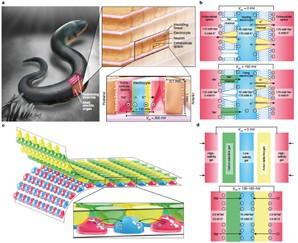
Figure: Electric Organ of the electric “eel” Electrophorus electricus showing so-called electrocyte cells (a) and the ionic transport processes at the membranes of these cells (b). Hydrogel lenses with different salt concentrations and different immobilized charges (c) mimic the electric organ and set up an electric potential difference when they are brought in contact with each other (d).
[1] T.B.H. Schroeder, A. Guha, A. Lamoureux, G. VanRenterghem, D. Sept, M. Shtein, J. Yang, M. Mayer, Nature, 2021, 552, 214-218
[2] A. Guha, T.J. Kalkus, T.B.H. Schroeder, O.G Willis, C. Rader, A. Ianiro, M. Mayer, Adv. Mat., 2021, 33, 2101757
[3] C.C.M. Sproncken, P. Liu, J. Monney, W.S. Fall, C. Pierucci, P.B.V. Scholten, B. Van Bueren, M. Penedo, G.E. Fantner, H.H. Wensink, U. Steiner, C. Weder, N. Bruns, M. Mayer, A. Ianiro, Nature, 2024, 630, 866-871
[4] C. Pierucci, L. Paleari, J. Baker, C.C.M. Sproncken, M. Folkesson, J. Paul Wesseler, A. Vracar, A. Dodero, F. Nanni, J.A. Berrocal, M. Mayer, A. Ianiro, RSC Appl. Polym., 2025, 3, 209-221.
Bio
Michael Mayer is Professor of Biophysics at the Adolphe Merkle Institute of the University of Fribourg in Switzerland. He received a Ph.D. in Biophysical Chemistry with Horst Vogel at the Swiss Federal Institute of Technology in Lausanne (EPFL), followed by postdoctoral research in Biological Chemistry with George M. Whitesides at Harvard University. In 2004, he started a faculty position in Biomedical Engineering and later in Biophysics at the University of Michigan. After attaining the rank of Full Professor in 2015, his group moved to the University of Fribourg, where he is currently the vice-director of the Adolphe Merkle Institute. His research draws inspiration from nature to solve problems in biophysics, ranging from studying the conformational dynamics of single unmodified enzymes during activity to characterizing protein complexes relevant to neurodegenerative diseases and engineering biocompatible electrical power sources.
This is a Joint Seminar with the EPFL Energy Center
Abstract
This talk will present attempts to design and assemble a biocompatible artificial electric organ that may be implanted into living organisms to generate electrical power. The inspiration for this work stems from the electric organs of strongly electric fish such as the electric eel and the torpedo ray.[1, 2] The talk will demonstrate that stacking hydrogel compartments with alternating high and low salt concentrations between appropriate hydrogel membranes enables powering a microcontroller and small electrical devices.[1, 2] It will introduce self-assembled block-copolymer membranes with macroscopic areas, which are stabilized by an aqueous two-phase system and provide an excellent barrier against the movement of ions.[3] These membranes are able to self-heal and can be rendered ion-selective by adding a molecular ion carrier. We use these membranes to present a first prototype of an artificial electric organ[3] and report on our ongoing efforts to power such artificial electric organs continuously.[4] The talk will conclude by discussing obstacles and possible future strategies for achieving the ultimate goal of converting metabolic energy into electricity inside living organisms.
Figure: Electric Organ of the electric “eel” Electrophorus electricus showing so-called electrocyte cells (a) and the ionic transport processes at the membranes of these cells (b). Hydrogel lenses with different salt concentrations and different immobilized charges (c) mimic the electric organ and set up an electric potential difference when they are brought in contact with each other (d).
[1] T.B.H. Schroeder, A. Guha, A. Lamoureux, G. VanRenterghem, D. Sept, M. Shtein, J. Yang, M. Mayer, Nature, 2021, 552, 214-218
[2] A. Guha, T.J. Kalkus, T.B.H. Schroeder, O.G Willis, C. Rader, A. Ianiro, M. Mayer, Adv. Mat., 2021, 33, 2101757
[3] C.C.M. Sproncken, P. Liu, J. Monney, W.S. Fall, C. Pierucci, P.B.V. Scholten, B. Van Bueren, M. Penedo, G.E. Fantner, H.H. Wensink, U. Steiner, C. Weder, N. Bruns, M. Mayer, A. Ianiro, Nature, 2024, 630, 866-871
[4] C. Pierucci, L. Paleari, J. Baker, C.C.M. Sproncken, M. Folkesson, J. Paul Wesseler, A. Vracar, A. Dodero, F. Nanni, J.A. Berrocal, M. Mayer, A. Ianiro, RSC Appl. Polym., 2025, 3, 209-221.
Bio
Michael Mayer is Professor of Biophysics at the Adolphe Merkle Institute of the University of Fribourg in Switzerland. He received a Ph.D. in Biophysical Chemistry with Horst Vogel at the Swiss Federal Institute of Technology in Lausanne (EPFL), followed by postdoctoral research in Biological Chemistry with George M. Whitesides at Harvard University. In 2004, he started a faculty position in Biomedical Engineering and later in Biophysics at the University of Michigan. After attaining the rank of Full Professor in 2015, his group moved to the University of Fribourg, where he is currently the vice-director of the Adolphe Merkle Institute. His research draws inspiration from nature to solve problems in biophysics, ranging from studying the conformational dynamics of single unmodified enzymes during activity to characterizing protein complexes relevant to neurodegenerative diseases and engineering biocompatible electrical power sources.
Practical information
- General public
- Free