IEM Distinguished Lecturers Seminar: Beyond Electrons: Bioiontronics from Cells to Humans
Event details
Date
28.10.2026
Hour
12:15
› 13:00
Speaker
Prof Takeo Miyake, Graduate school of information, production and system, and Department of Electronic and Physical Systems, School of Fundamental Science and Engineering, Waseda University, Japan
*** Drinks and pizza at 11:45 in the lobby of BM 5202 ***
Abstract
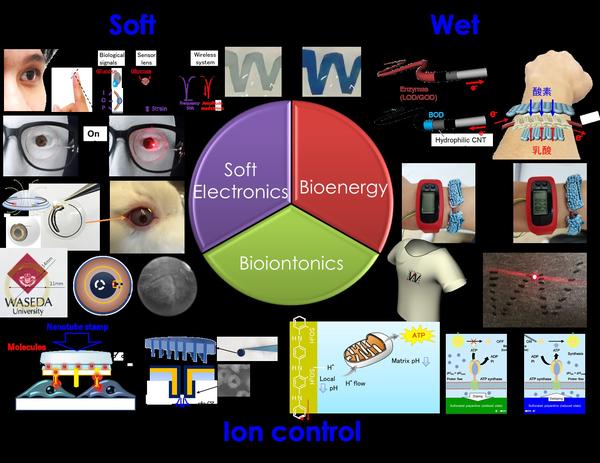
Controlling the flow of ions and electrons at the device/human interface has become an important challenge in broad fields such as bioelectronics and medical biology. These devices provide a new way to translate bidirectionally between the ionic language of biology and the electronic language of circuitry. To this end, we need to overcome an interface mismatch between devices and humans because the mechanical properties of a device are hard and rigid compared with our soft body. In addition, devices usually control electrons, while the human system controls ions. However, most electronic devices don’t work when wet. So, our research focus is on the electron-ion interface for emerging devices.
1. Soft electronics for interfacing devices and humans.
2. Bionic system for wetware engineering.
3. Ion-controlling devices for interactive communication with biology
Fig. 1. Research topics in Miyake’s lab
Bio
Takeo Miyake, Ph.D., is a Professor at the Graduate School of Information, Production and Systems and the Department of Electronic and Physical Systems, School of Fundamental Science and Engineering, Waseda University, Japan. He received his B.S. in Electrical Engineering in 2004 and his Ph.D. in Nanoscience and Nanoengineering in 2008 from Waseda University, where he conducted research under Professors Iwao Ohdomari and Takashi Tanii. He was subsequently awarded a Research Fellowship for Young Scientists by the Japan Society for the Promotion of Science (JSPS).
In 2009, he joined Tohoku University as an Assistant Professor in the Department of Bioengineering and Robotics, working with Professor Matsuhiko Nishizawa. He later moved to the United States and conducted research with Professor Marco Rolandi at the University of Washington and the University of California, Santa Cruz. In 2016, he returned to Waseda University to establish his independent research group as an Associate Professor and was promoted to Professor in 2021.
His research focuses on bioelectronics and bioiontronics, particularly the development of soft and wearable bioelectronic devices, smart contact lenses, and micro/nanodevices for interfacing electronics with living cells and tissues.
His honors include the Incentive Prize from the Aoba Foundation for the Promotion of Engineering (2013), a Poster Presentation Award at the Nature Conference “Flexible Electronics – Visions of a Flexible Future” (2018), and the Young Scientists’ Prize of the Commendation for Science and Technology by the Minister of Education, Culture, Sports, Science and Technology (MEXT), Japan (2020) and so on.